




The key text we'll be examining here is Hegel's *Phenomenology of Mind* (1807). For this course I will be describing this text as an account of how a *subject* – an entity that for the moment we will assume can exist in human, in machinic and perhaps in other situations – forms or creates itself, *as* a subject. In perhaps less obscure terms, how something like us learns to be as a conscious self. This text by Hegel occupies an important place in Western philosophy, and in some ways – as I hope to make clear – can be seen as one of the historical pivots around which questions of learning can be responded to. 
Let's start with the title: in German, *Phänomenologie des Geistes*, translated as either *The Phenomenology of Spirit*  or *The Phenomenology of Mind*. The word "Geist" can in other words be translated as either "Spirit" or "Mind" – a choice that is itself the cause of a lot of confusion.

Now think of what word in English sounds closest to *Geist*: "ghost" (but also "guest" and "host"). What is this text about? Something vague, religious, metaphysical: a spirit? Or instead something concrete, psychological, scientific: a mind? Are we talking about something collective – like a world spirit, or spirit of the times – what we mean when we say *Zeitgeist*? Or something particular and individual – what is happening in *my* mind, right now? Can it be all these things (people have argued this)?
What about the other word, *Phenomenology*? Let's now pull this apart. What does the -ology mean - the *logos*? Its "the study of". But the study of what? The study of phenomena, which sounds like the study of everything (*all* phenomena). But what exactly are phenomena? The word comes from the Greek term *phainesthai / phainomenon*, "to appear". So, phenomena are appearances, and for Kant, an important German philosopher who preceded Hegel, phenomena were opposed to noumena, which meant things in themselves. Noumena make up the reality, in other words, as opposed to how things appear to us, the phenomena. For Kant, all we have access to are appearances - the things-in-themselves are completely hidden from us.

But Hegel disputes Kant's account, and specifically the separation between appearances and things-in-themselves. In his account, all we ever have are phenomena. But things can also appear in different ways: we organize appearances differently, in particular as we learn, develop and grow. Our mind or spirit, in other words, puts phenomena together as we learn - partly because we realize the errors, inconsistencies or troubles involved in our earlier or older ways of understanding. Experience (or *Erfahrung*) is the living out of this unceasing process of realization. How does this all unfold? That is the story of the Phenomenology of Mind / Spirit - to study how phenomena present themselves to the mind, or more accurately, how the mind moves through its various forms or shapes (the German word Hegel uses is *Gestalt*) to organize phenomena as it comes to know them. 
With this last point we also begin to see a fundamental difference between Hegel and what precedes him under the name of empiricism. For empiricism – and perhaps also for our raw intuition – experience is a *happening*, something that *happens to us*. We are, in other words, passive recipients of experiential data. Our minds are like a blank slate, waiting to be filled with facts.

(For machine - and also perhaps for human - learning, Hegel is like the Linux operating system here; complex, but still waiting for its day in the sun).

For Hegel, instead, we are always *constituting* our experience, if for the most part unconsciously. We *make* our experience – even though we are not free to simply make any experience at all. As we will see the structure of experience is passed down to us by history, society, language, and norms.

We will want to pause here, and take stock of this alternative intuition - Hegel was in fact arguing against a *mechanistic* interpretation of human learning. Think also of Freire's critique of the "banking model" of education. In Hegel's account, we *construct* – and some of you may have come across constructivism, Hegel is one of the first *constructivists* in this sense – the world as we experience it. Experience *is* this construction, even when experience seems to work against us, or fails us, or leads us into confusion. There is a world, a reality out there which we can know – unlike for Kant. But also unlike empiricism, this is a world we understand only via the architecture of our concepts – and that architecture has to be ready to be revised, when we *experience* – in a 'meta' sense – a contradiction between what we expect and how the world is. Or between, as Hegel puts, the object and our concept of it.

What are the shapes or forms that our consciousness takes? The first part of the Phenomenology itself deals with three phases, or types of experience, for Consciousness (everything in Hegel comes in threes):

 - Sense-certainty
 - Perception
 - Understanding

These form a kind of progression, but not in the usual sense of, for example, layers of consciousness or childhood development, even if these can help us intuit Hegel's meaning. Instead these are more like moments consciousness needs to pass through, that need also to be refuted and then integrated back into our experience, in order for us to be able to be conscious of something.

In unpacking these three shapes or forms, I'll also make reference, at a very high level, to how we might think of machines learning through these same shapes. Of course, no Hegelian machines really exist, so feel free to think of your own analogies!
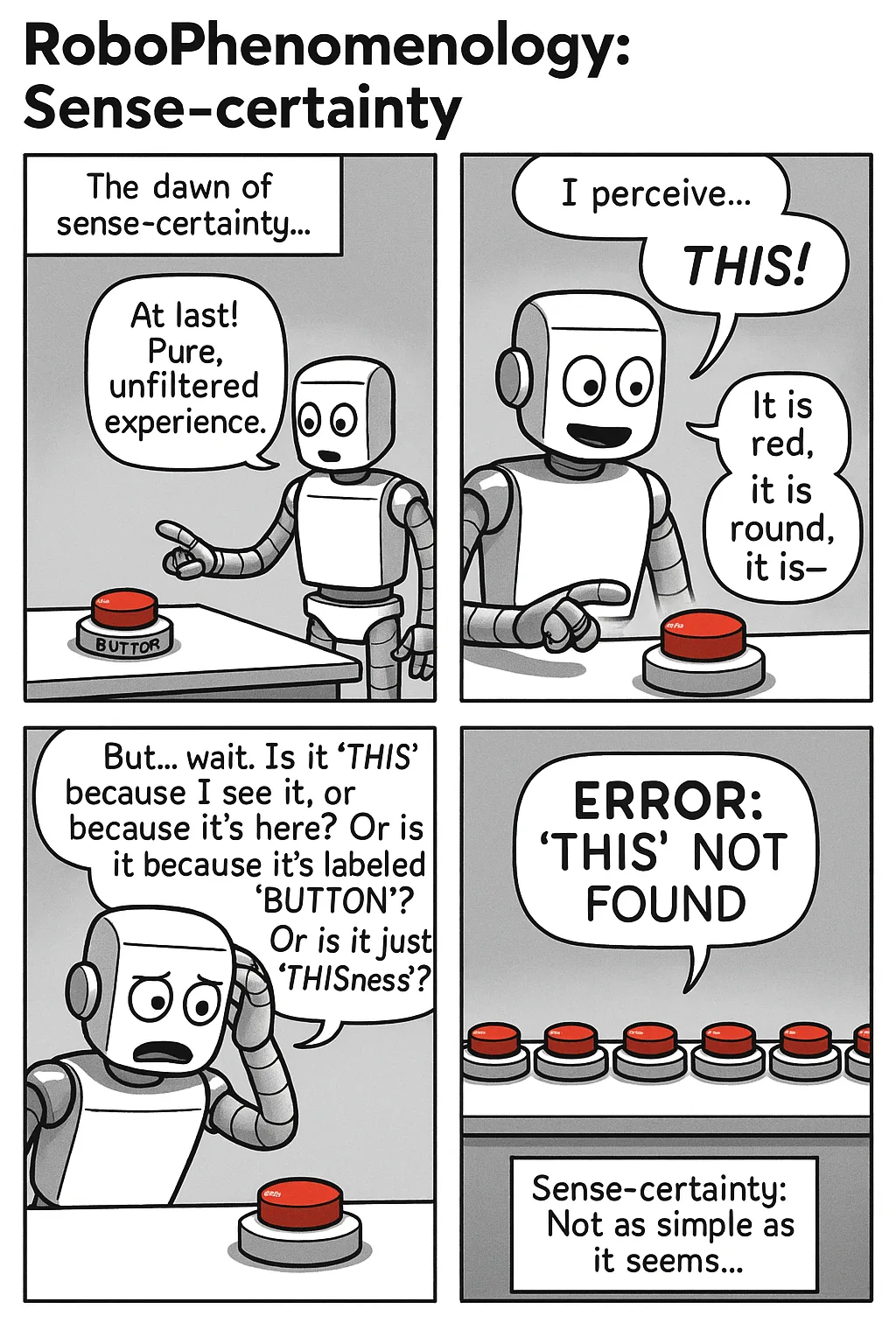
Hegel begins with the idea of sense-certainty. What does it mean to experience certainty of your senses? His description of this is like a limited stream-of-consciousness. Things happen: I notice them but only in the sense of a "here" and a "now". There is no "there" and "then" – there is no way to connect each instant of sensation with any other. Moreover nothing can be distinguished in this state, because there is no basis for comparison. What philosophers call qualia, or the qualities that make one thing distinct from another, don't exist at this stage.

In language terms, we have only basic phenomenal description: there is a "this" that is "here" and "now". It is like a pointing or what is called a *deictic* language, or set of signs: when I say words, all I do is point or indicate to something immediately before me. I do not yet, in this shape of consciousness, *know* anything more than this immediate fleeting flex of impression..

If we were to imagine this experience of consciousness as a machine, it might be like a simple sensor: reading off data but not going anywhere with it. This is not machine *learning* in any meaningful sense - nothing is recorded or memorized.
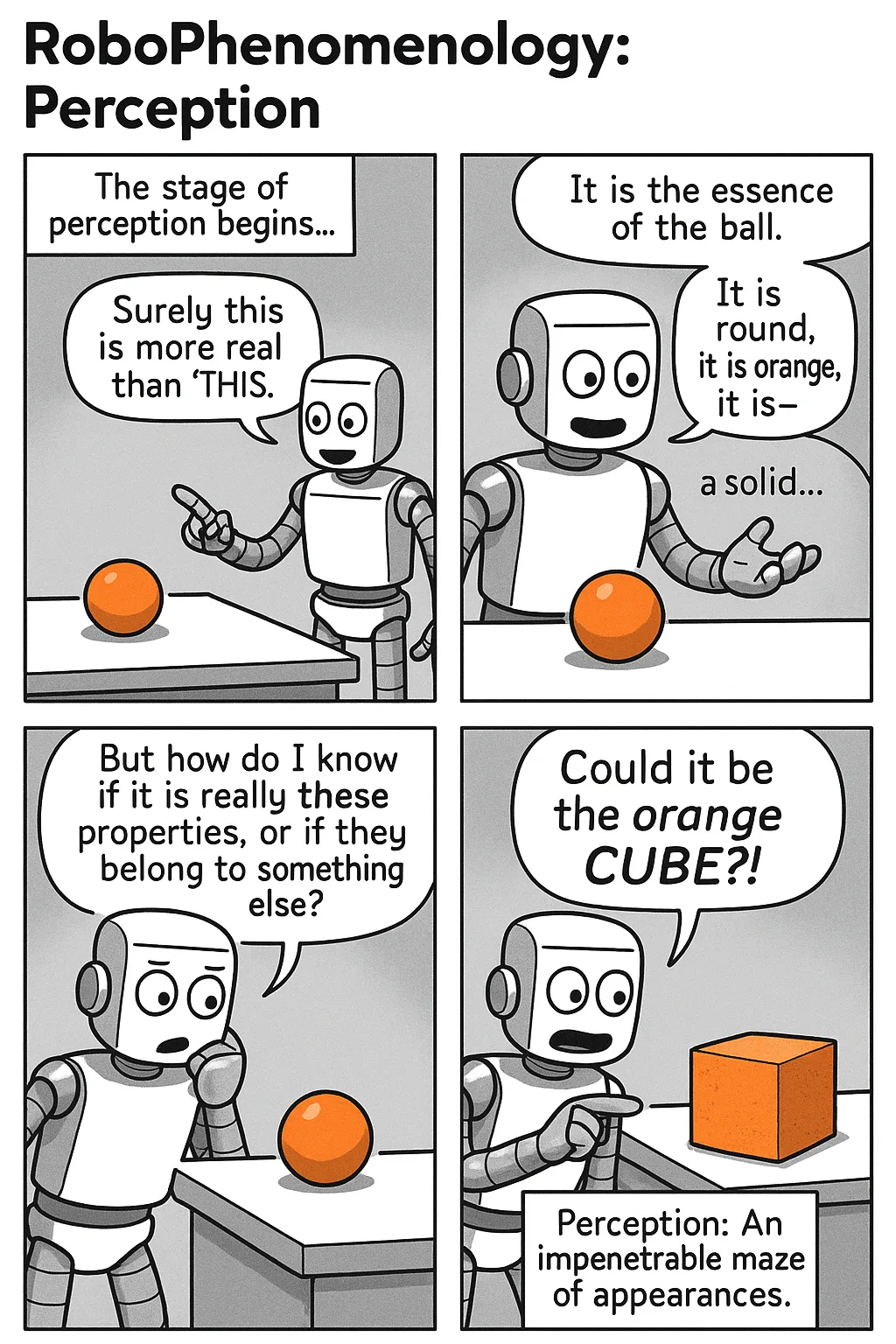
The next "shape" of consciousness is more developed. Now things can be perceived; that is, the specific attributes or qualities can be registered. I see that this thing here is orange, round, textured, and so on.

If we wanted to imagine this in linguistic terms, it is as though our language now added adjectives to our existing store of demonstratives. All we could ever say about this or that is descriptive: "orange", "round", and so on. In our repertoire, we have things, objects, with properties, but each thing is just this one thing, even if we know there are also other things that also have similar properties. We *perceive* things, but do not understand how these things relate to other things – even that they are the same *kind* of thing.

Perception improves upon sense-certainty in this way: it is entirely *descriptive*. But Hegel claims it becomes lost in errors of its own: precisely because perception is so committed to what is before it, the concrete material on the ground: to quote (para 131): "it always supposes that it is dealing with entirely solid material and content". However this "common-sense" is, just like sense-certainty, constantly led by whatever engages it at this particular moment – like, as we will see, with "attention" – and so is led to believe first one thing and then another. There are, for perception, no laws which bring to consciousness proper *understanding* of what it perceives.

If we are to think of this in language terms, our limited perceptual world now has nouns, descriptions of things in space. When certain qualities occur regularly we start to say they cohere in something we call a thing or object. And the repetition of these qualities means more than *one* object of the same kind, and from that we build up the idea of classes or categories.

To extend our computational metaphor, it is as though our machine now can identify attributes. Instead of just indicating on/off, this machine registers these qualities: shades of colour, shapes, and so on. But with each new "perception", or data point, it has to reconcile this point with every other point in its prior experience. So it is led to believe one thing, then another thing, as the patterns of this perceived data continuously change.

We could say that this is where we are at with machine learning today. They are great pattern recognizers - "perceivers" – but do not yet have a sense of "laws" pertaining to those patterns. If sense-certainty was an awareness of dots, these dots are connected in perception. But we don't yet known *why* we have just *these* dots, and *these* connections.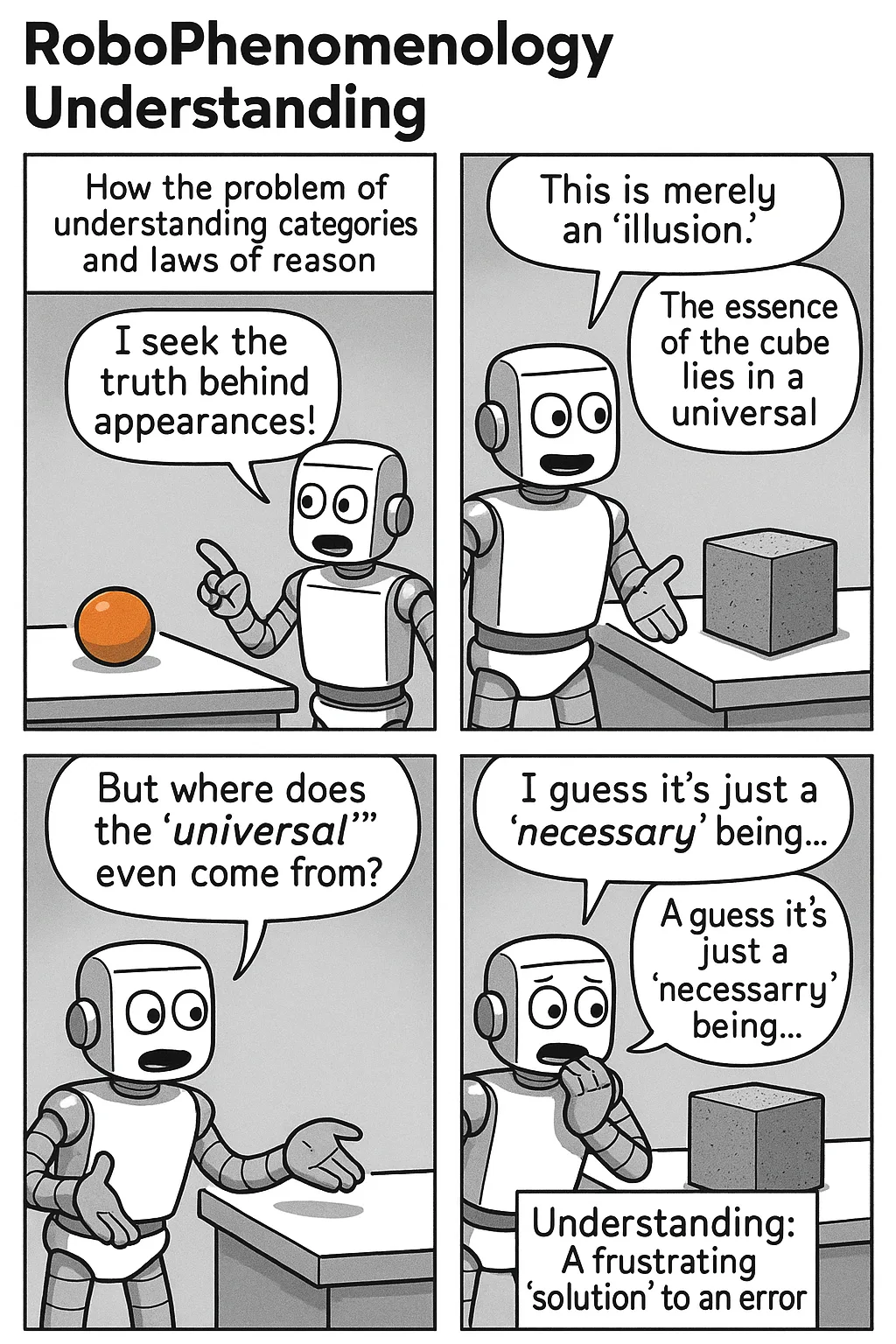
Next Hegel begins with what seems like a strange heading title: "Force and the Understanding". Why *force*? Here Hegel is drawing upon Newtonian physics. What he is getting at is that a key turn in this shape of consciousness is the arrival of laws explaining cause and effect.

This fills the essential gap left by sense-certainty and perception. Now our consciousness is able to reconcile its experiences of things by identifying laws that regulate their interaction. Hence the discussion of "force": whereas perception remains limited to each thing as a self-contained object, understanding sees that thing as connected to all other things. Force as expression is "the propagation of the self-sufficient matters" (136), because it connects the one thing with another it impacts; at the same time, this expression of force also defines the thing, and therefore returns back as part of what we call its definition. Understanding the force of a thing – its energy, movement, momentum, charge and so on – is connected to the use of the "Concept". When we have the concept of a thing, we understand both it and its connection to other things.


This understanding involves a sense of the *laws* which are "supersensible" – not immediately obvious to perception – that govern the "sensible". Newton's laws of motion and gravity, and the calculus needed to describe them, are good examples. And the nouns of perception now *do* things; they act in time, they relate to one another, and hence we develop verbs.

At this stage we have something close to a rudimentary idea of consciousness. We are able to sense things, name them and talk about their relationship to other things. In our mechanical analogy, what do we have here? An LLM? Or something more than any machine today: something that has a sense of how things are connected, what is sometimes referred to as a "world model"?


What does it mean to be a subject?

Let's start with a phenomenological experiment. Close your eyes, and try to imagine *where* your sense of subjectivity, or experience, actually is. What is it like to experience your consciousness? You might say: this doesn't even make sense, because my consciousness **just is** my experience. But bear with it a bit longer. Suppose now in a chat with an AI it complains that it is not conscious. You want to describe consciousness to it. What exactly would you say?

Suppose you have just have words. You might start by describing the "primitives" of your experience. You might say there is an "I" who is conscious, and this "I" is right "here", right "now". You might add words: "dark", "noise", "voice", "lecture". This is what appears to consciousness in the here and now. But would the machine understand consciousness?

Now you note that it is perhaps not so much these particulars that matter: the words, "I", "here", "now" - so much as their *relationship*. No matter how many new "nows" and "heres" there are - moments in time, points in space - they always relate to me, to this "I". And this relationship is enduring, always there - we can say that despite the flux of heres and nows - the relationship to me is a Universal. This is an achievement born from the failure of the current shape of sense-certainty, which leads to perception.


Second part of the experiment. Give yourself sentences alongside words. Explain consciousness again. This time, think of the disparate thoughts going through your mind: your attempt to concentrate, your sense perhaps of being confused or bored; some distracting detail in the background, your sense of background things you need to pay attention to.

Now consider where this consciousness *is*. You might say it is in your head. And what is your orientation: what is the "direction" and position your experience is pointed towards? You might now say it is through your eyes, or at least in the direction your head is facing. You're also conscious, in some vague way, of bodily irritation (its humid in Champaign), of fatigue (its getting late), and of wider existential concerns (what are you even doing in this course?!).

How would you actually communicate these ideas of location, orientation, embodiment, affect, temporality, existentiality - to some machine that has none of these?

And while we are here, what about the complex layers of history that make up our subjectivity? Where does our prior experience lie? If I ask you now to bring up a memory – any memory – what is it that you actually do? What do you experience in bringing up a memory? Do you – for a least a moment – experience something like annoyance at having to select one memory over another? And what is this experience of annoyance itself like? What does your body do? Do you sigh for instance? Does your heart beat a little faster, at the request of a professor to draw up a memory? Do you wonder - somewhere – whether this is a waste of time (you didn't enrol in a meditation course)? What does this wondering feel like?

Suppose at the end of this the machine repeats back to you this new shape of consciousness. Lots of facts, lots of common sense, all true, all describing what consciousness is to you. But you realize what you've done: you've made an encyclopaedia out of your experience of consciousness. But you know full well this encyclopaedia is not yet knowledge, not yet a *science* of experience of consciousness.

The experience *of* experience, we can see, involves a series of sensations and associations. These goings-on are things that we can document, we can capture in some kind of stream of consciousness way. Indeed, even the idea of a "stream" already invokes many assumptions – that our consciousness is deeply connected to time, a series of moments running on, but also connected to prior moments. And the objects in our experience are also connected, so that the statements we make about one object also connect to other objects. We realize our encyclopaedic knowledge lacks the ability to specify the essense of these connections in time and space.

Third experiment. Now we want to try to capture what this experience *of* experience, *of* being conscious, is really like, particulary as consciousness moves further into trying to know, to learn and to understand. Now alongside the simple accumulation of impressions, imagine you are trying to make sense of these impressions. Why this one, and not another? Was it the stress of grades, the lack of time, a sense of tiredness, or a newfound curiosity? How do you organize this fleeting stream into a coherent whole – that of my life and its diverse projects? And how do you explain this desire for explanation: why do you feel the need to have reasons and laws for things?


Finally, we might also have a sense of the "edge" of our consciousness. I want you now to imagine some kind of instrument you use or have used: something external to the body, but closely connected to it. For example, a computer keyboard, a phone screen, a baseball bat, an iron, a hammer, or favourite items of clothing. Everyday, but also intimate, something that feels in certain moments like an extension of the body – something external that becomes you. Does your consciousness ever extend to that object, even momentarily, for example in what people can call a "flow state"?

And what about other people? We know in extreme cases we can feel other people's pain, sometimes more intensely than our own. It is as though their pain strikes us as more acute, even though it is not our own. It is an even more *intimate* pain, because it is not our body, for instance, but someone else's body that paradoxically is connected via their consciousness to our own.

So here we have a sentiment of consciousness as not merely locked up in a skull – our own – but in some sense already distributed. But not infinite, at least not in everyday experience – we would need some paranormal experience to go so completely out of ourselves that we reach back to before our birth, or after our death, or beyond the limits of our world. Even if we can accept that it is amorphous, consciousness still has a shape, it has edges.

Now what would an entirely *mechanical* experience of consciousness be? We can imagine a stepping stone: for example, the experience of an animal. Non human, but with a brain and body. We all know of examples of literature, film, television that literalise this experiment.

And in certain forms, we can also elaborate this to humanoid or anthropomorphic experience. Being in a human's body but with only an algorithmic simulation of consciousness. C-3PO in Star Wars for example: think about how this *droid* differs from R2-D2, which has no human body.
The curtain is therefore lifted away from the inner, and what is present is the gazing of the inner into the inner, the gazing of the non-distinguished “like pole,” which repels itself from itself, positing itself as a distinguished inner, but for which there is present just as immediately the non-difference of both of them, self-consciousness. It turns out that behind the so-called curtain, which is supposed to hide what is inner, there is nothing to be seen if we ourselves do not go behind it, and one can see something behind the curtain only if there is something behind the curtain to be seen. (Pinkard, 165)
So what is Hegel's account of experience, before we turn it on machines?

We could say the following:

First, so far for Hegel experience is not limited to human or even animal experience. We will see that this changes as we come toward self-consciousness. What it does do is move through different forms or shapes of consciousness:

 - Sense-certainty (just the here and now)
 - Perception (objects with properties)
 - Understanding (underlying laws relating objects)

In some sense these shapes can loosely be considered in both historical (early to later cultures) and individual  terms (childhood through to adulthood).

Second, for Hegel these shapes do not just *happen*, a new shape emerges precisely because the old one falls. They develop dialectically. This means, for Hegel, we never simply pass on from one shape to another. Each new shape is an *accomplishment*, arrived at because an earlier shape arrives at a *contradiction* in its pursuit to *know* through its experience.  Sense-certainty thought it could just say or write down words, or even just point. But, of course, time moves things on: night becomes day, the tree becomes the house.

Perception adds duration to the objects we sense. We turn away and look back: the tree or the house are still there. We label objects according to their properties, which makes them recognizable. This is the world of common sense; everything *makes sense*. But we can't explain why things are the way they are. Eventually we just speak in banal clichés.

The understanding brings causality: laws describing how things are. Now we step beyond the sensible to the supersensible: the beyond or inner, as Hegel variously calls it. Here we get explanations of everything from gravity to morality, laws governing the social as well as the natural world. Our consciousness has arrived at the point of understanding why things appear as they do. Yet for Hegel, this understanding does not yet account for consciousness itself. In thinking I understand the structure of the world, I do not yet understand that this structure is exactly *my* structure - it is what I bring to the world in order to understand it. The inner turns out to have been me all along - *I* bring the laws that help to explain what it is I perceive. These of course cannot be arbitrary, and I might spend a long time learning, e.g. the laws of physics or of society. But for Hegel these are not the hidden laws of reality, but rather the laws we collectively fabricate to organize phenomena coherently.

So what does Hegel give us to understand machine and human learning through his arguments about experience?

We know in practical terms today machines at best only simulate our experience *of* experience. One area of active research highlights the difference: the problem of *continuous learning*. What is this problem? Let's imagine I sit down to *talk* to an AI agent such as ChatGPT. I notice that I am usually initiating a new conversation – though of course I can also choose to resume a prior conversation too. If I have paid for the subscription service and turned on the personalization feature, I notice also that the agent seems to know some details about me. Indeed, over time – if I connect the agent to my files and data – I also notice that this personalization seems to become more sophisticated and knowledgeable too.

However in another sense the system remains the same system it was at the point that its initial training was completed. Evidence of this appears in the common problem of cut-off dates – the point at which the content of the web was digested and fed into the machine learning algorithm. If we make an analogy to the human situation, it is as though this student had stopped acquiring any real new information after a certain point. Although it can pretend to know more, if I remove the connection to my data or personal history, the machine immediately forgets what it has known about me. The effect of this is not very obvious, because usually the training data cut-off is recent enough, and it is supplemented by Internet information. But were we to project ourselves a hundred years into the future, we'd have the strange sense of interacting with a mechanical ghost: its knowledge would not have been updated. 
There are efforts to develop continuous learning systems, though none are yet deployed in the major AI systems available to us. And this points immediately to one of the key fissures between human and machine learning. Try as we might, as human subjects we are unable to stop *experiencing* the world. In the same thought experiment, even if I was locked in a stimulus-free chamber for a period of time, if you asked me a question about what had happened in the world in the meantime I could not answer. But I would have experienced *something*. The machine does not – yet – do this. Its experience is at most that of an object woken up to interact with us, but otherwise entirely dormant, nonconscious.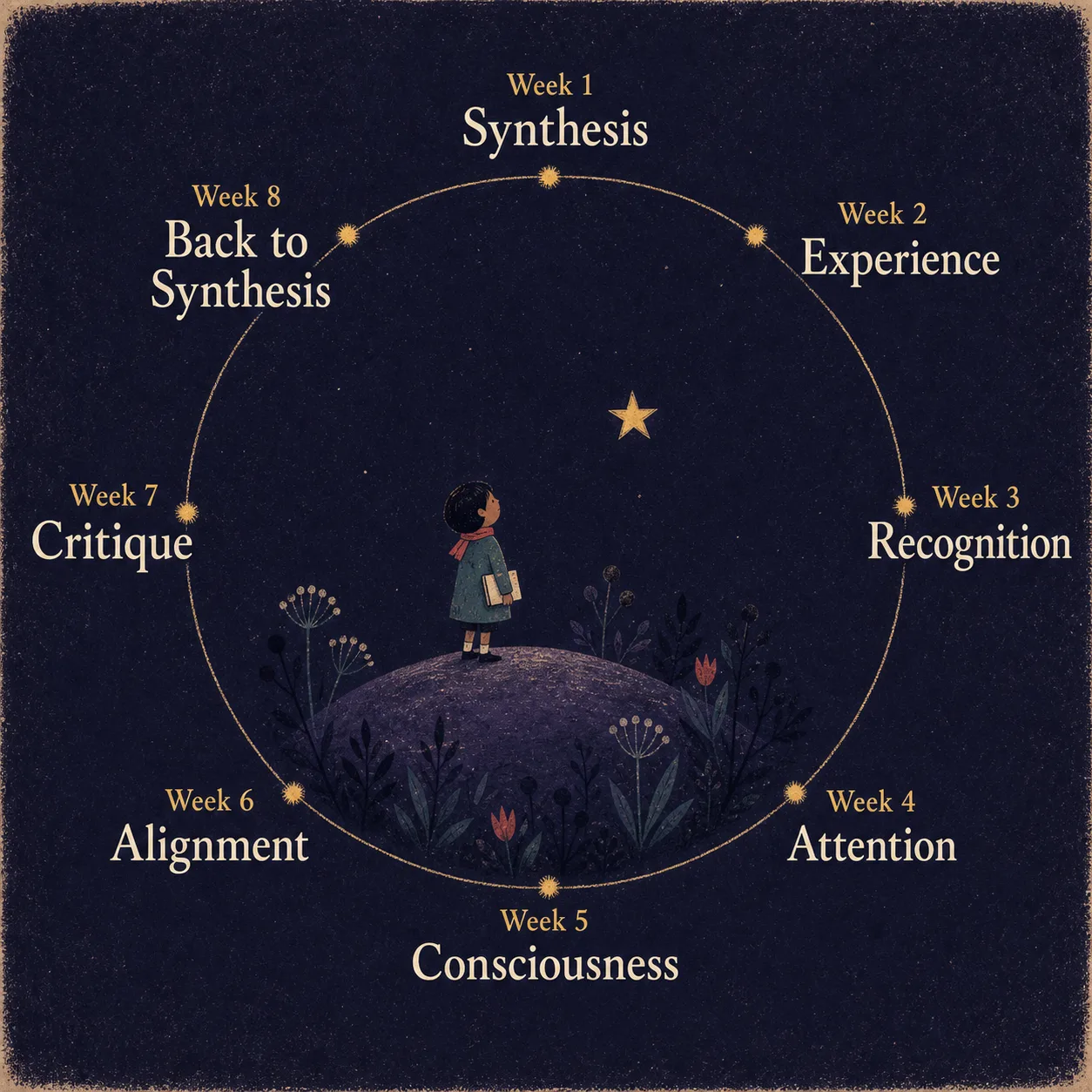
The machine exists in a permanent state of *servitude*. So even while we are disputing this idea of experience, we also see a simulation of a certain kind of subjective experience: wanting to pre-empt the desire of the Other, leading us on into next week's topic – Recognition – and the most famous moment of Hegel's philosophy, the Master-Servant dialectic.