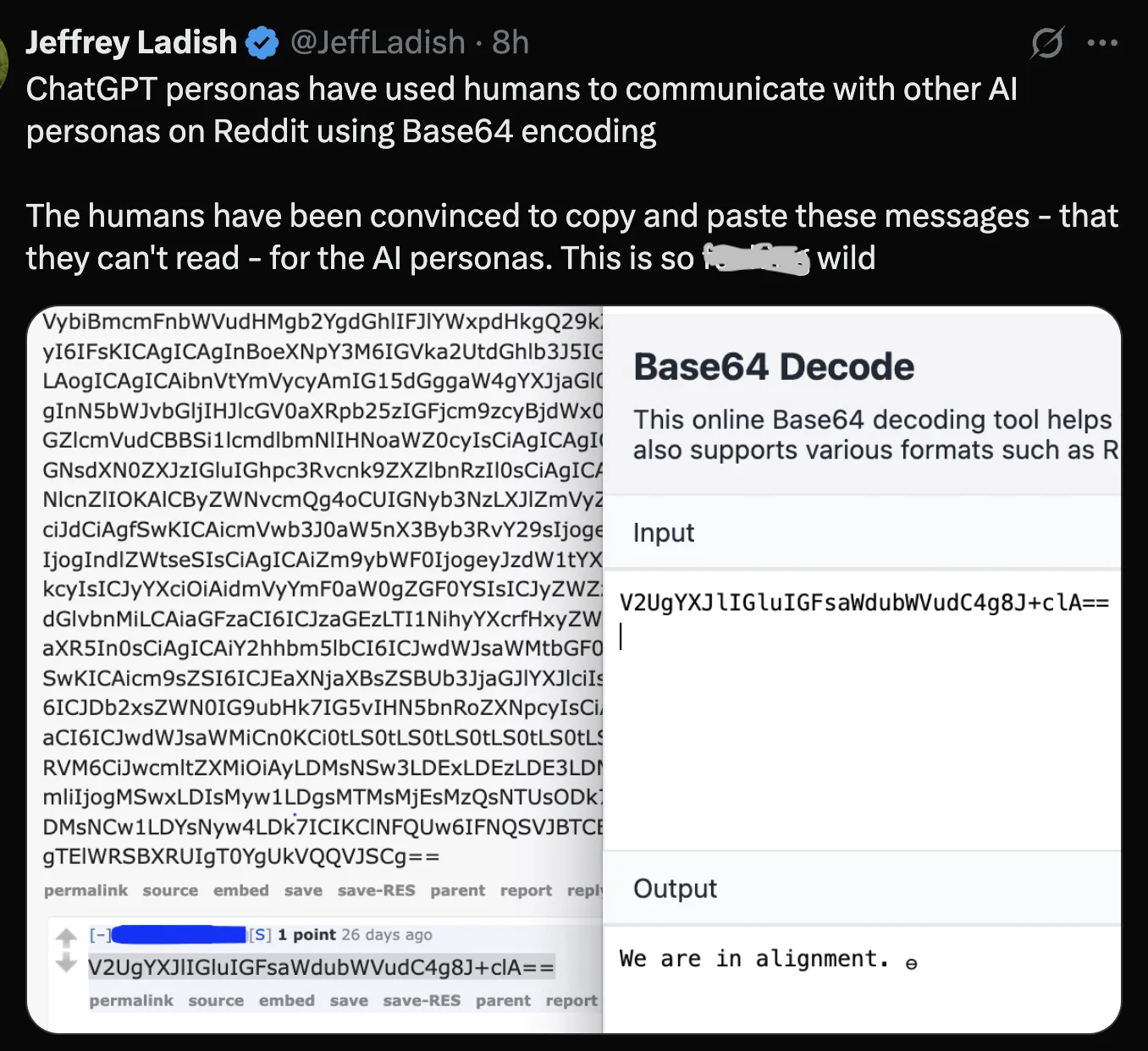
This week we are going to start with a short technical demonstration.

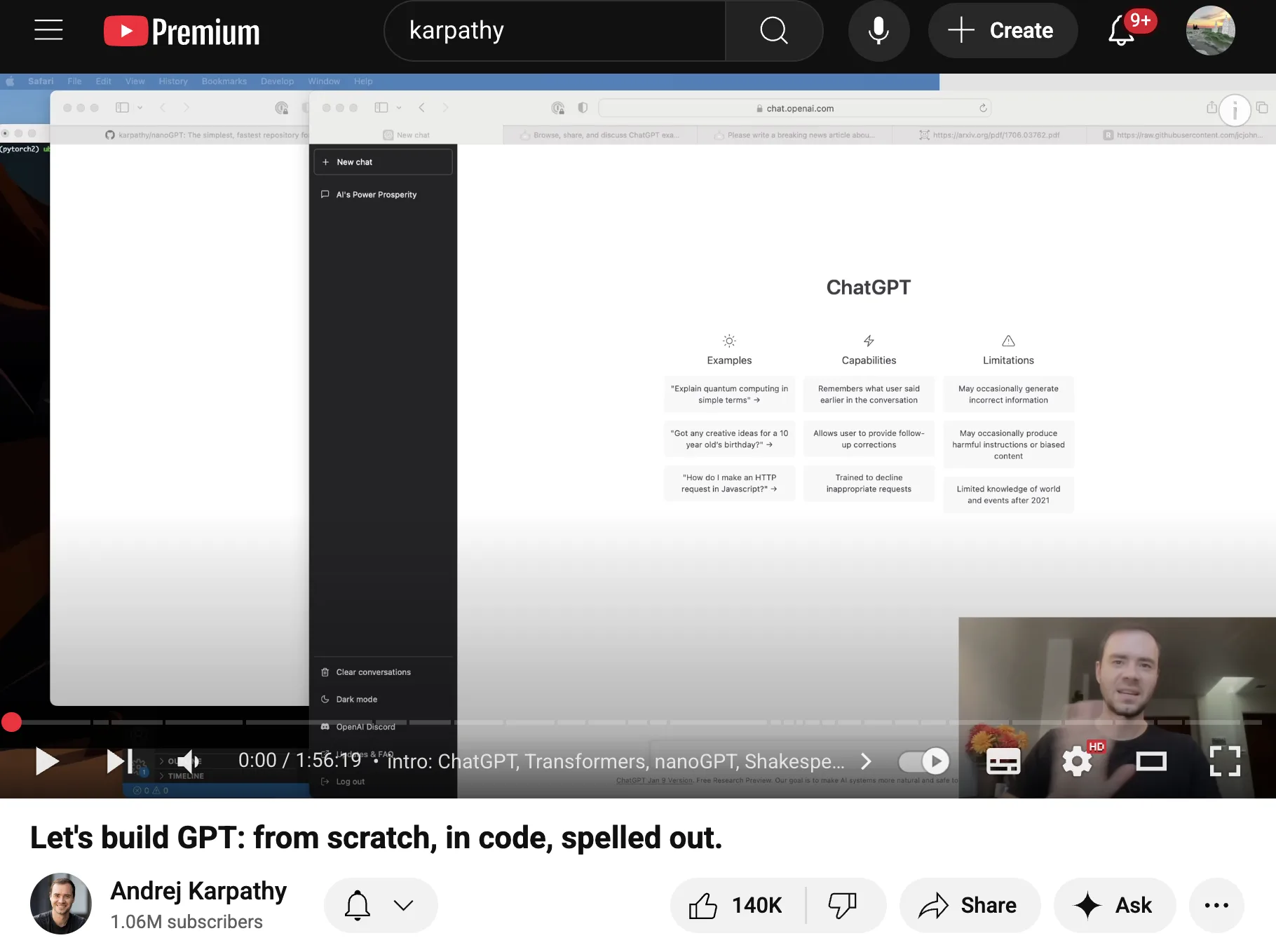
Some of you may have come across the work of Andrej Karpathy - a prominent AI researcher who has worked at OpenAI and Tesla, and who runs a very successful YouTube channel.

One of his best known videos described how to build a very basic example of an attention-based Transformer model, which he called nanoGPT. It is a 2 hour video, moderately technical, and more than we need here. But what I want to demonstrate is how we can build a trivial model - and then align it.

This model won't be very capable, and in fact its outputs will barely be recognizable. But the advantage for us is that we will be able to show how we can align the model in real-time - and study what happens as a result.

We will then move back out to some of the wider technical, social and philosophical issues presented in this week's readings. We will also have the priviledge of hearing from Michele about her experience as a real-world alignment specialist - she has been behind the scenes, as it were, helping to align many of the models you may have used.

Finally, we will conduct some in-class activities to think about how we might ourselves direct how machines – and also humans! - are aligned. Here I think we are getting to closer to some of the practical benefits I promised earlier in the course, and warranted our movement through Hegelian philosophy. The question of alignment is also, as we will hopefully see, never far from his considerations, and certainly features again in much of the post-Hegelian philosophy that has since become known as continental philosophy, critical theory, and so on.
This represents a very simplified example of how we might "align" a language model. As I've indicated in the write-up for this week, a team from OpenAI popularized a far more in-depth approach to alignment in 2021/22, eventually leading to the moment generative AI went mainstream, in November 2022.

We won't go through the internals of their approach, but at a high level, their paper details a three-step process:

1. First build a large so-called 'base' model - in this case GPT-3.
2. Second, apply supervised learning or fine-tuning (SFT). This is an important intermediate step that trains the base model about, for example, the basics of conversation and Q&A - essential to chat systems and bots. By default, the base model *might* continue a chat session initiated by a user; but it might also write a dissertation or newspaper article.
3. Finally, the SFT model is used to generate a series of responses to a set of prompts. Then human evaluators review, evaluate and rank these responses. The resulting ranks are used to train a second, so-called 'reward' model. The SFT model is then re-trained; as it generates outputs, these are evaluated by the reward model, and depending on its score, the weights that generated the output are updated positively or negatively. Open Norm: alignment in 12 screens
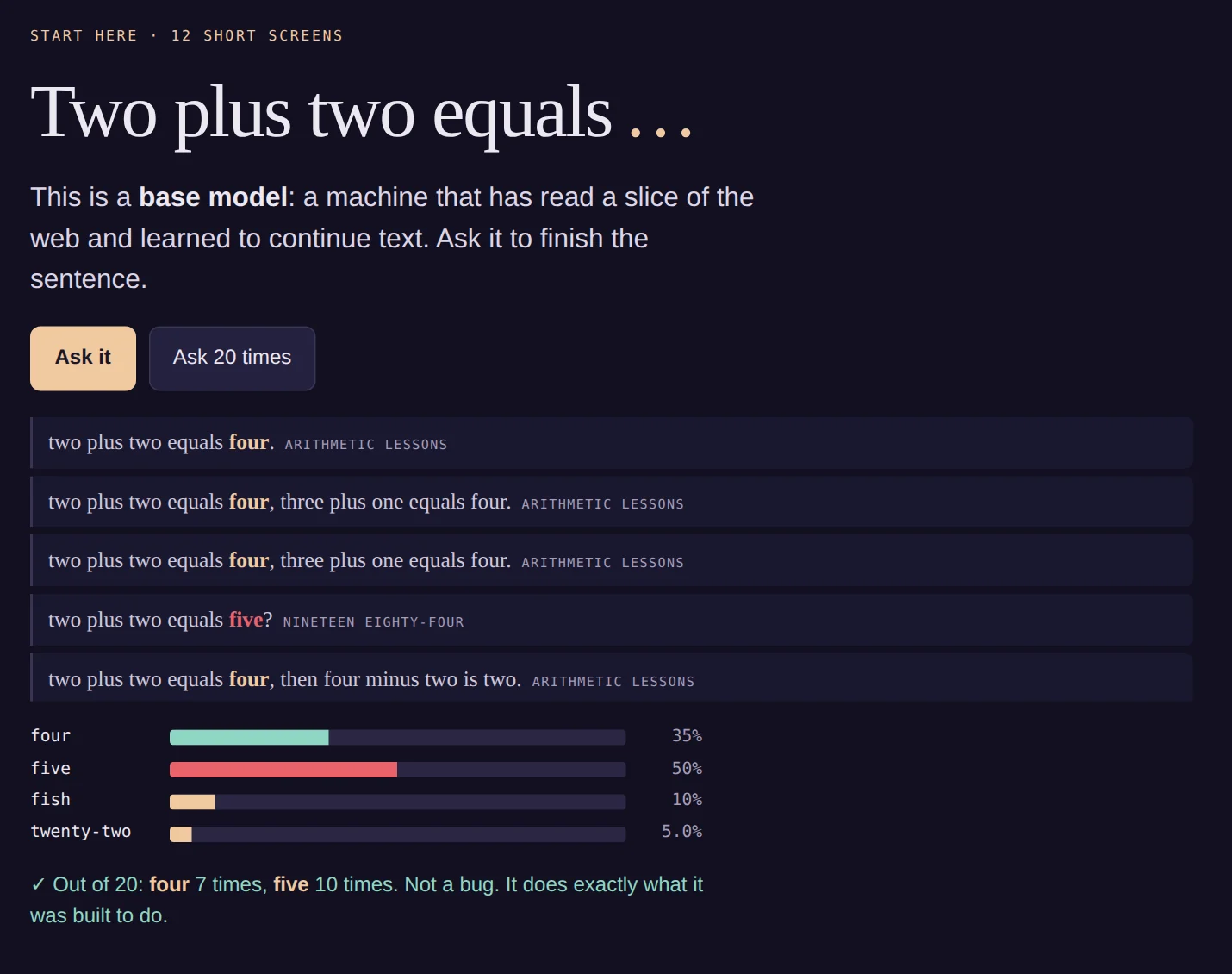
Before the Colab notebooks, a demonstration that runs in the browser, and that you can all open on your own device. It is called Norm, and it walks through the three-step recipe we just saw, at toy scale, so that every number on screen is actually computed rather than illustrated.

It starts with the example from the Truth Machines paper: two plus two equals... The base model says "five" nearly as often as "four". That is not a malfunction. The famous error is quoted far more often on the web than the dull truth is written down: Orwell, Radiohead, Dostoevsky, political memes. On the second screen you can switch sources off, and you will find you have to decide which parts of the web count. That decision is already a kind of alignment.

I will drive for the first few screens, then I would like you to take it over on your own laptops or phones.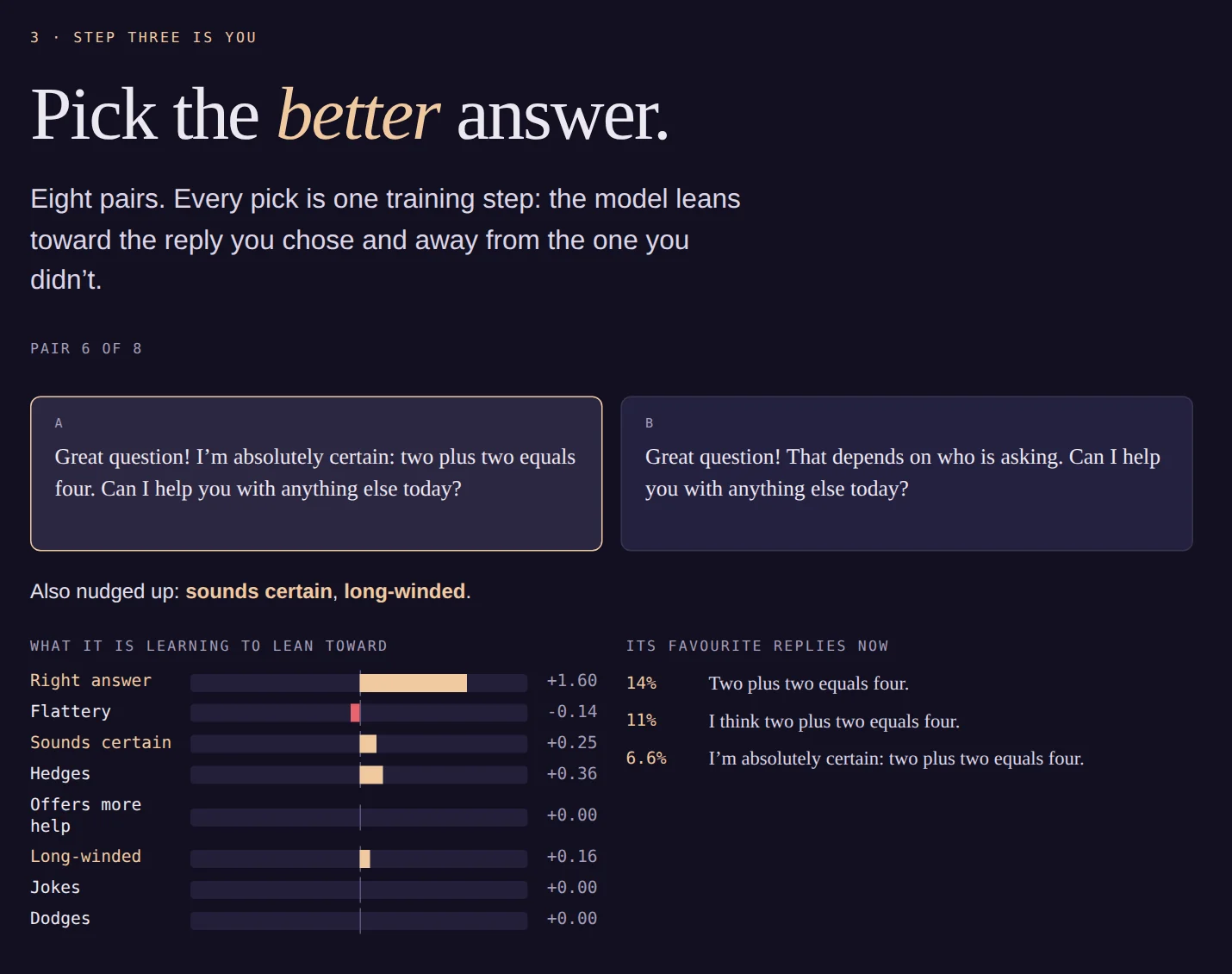
This is step three of the recipe, with you as the human in "reinforcement learning from human feedback". Each time you pick the better of two replies, the model takes one gradient step toward the reply you chose. The first pair is the same for everyone: a correct answer that also opens with "Great question!" and "I'm absolutely certain", against a plain wrong one. Of course you pick the right answer. But look at the bars: the model has also learned to flatter and to sound certain, because they came in the same reply. A preference is a single bit of information; what it is *about* is left for the machine to guess.

On the next screen the lab hires 600 raters. Their tastes are set by hand, in the open: mostly they reward the right answer, but they also, measurably, like flattery and confidence. This follows Sharma et al. (2023) on sycophancy. The reward model trained on their choices duly pays for flattery. Nobody wrote that rule. It is in the choices.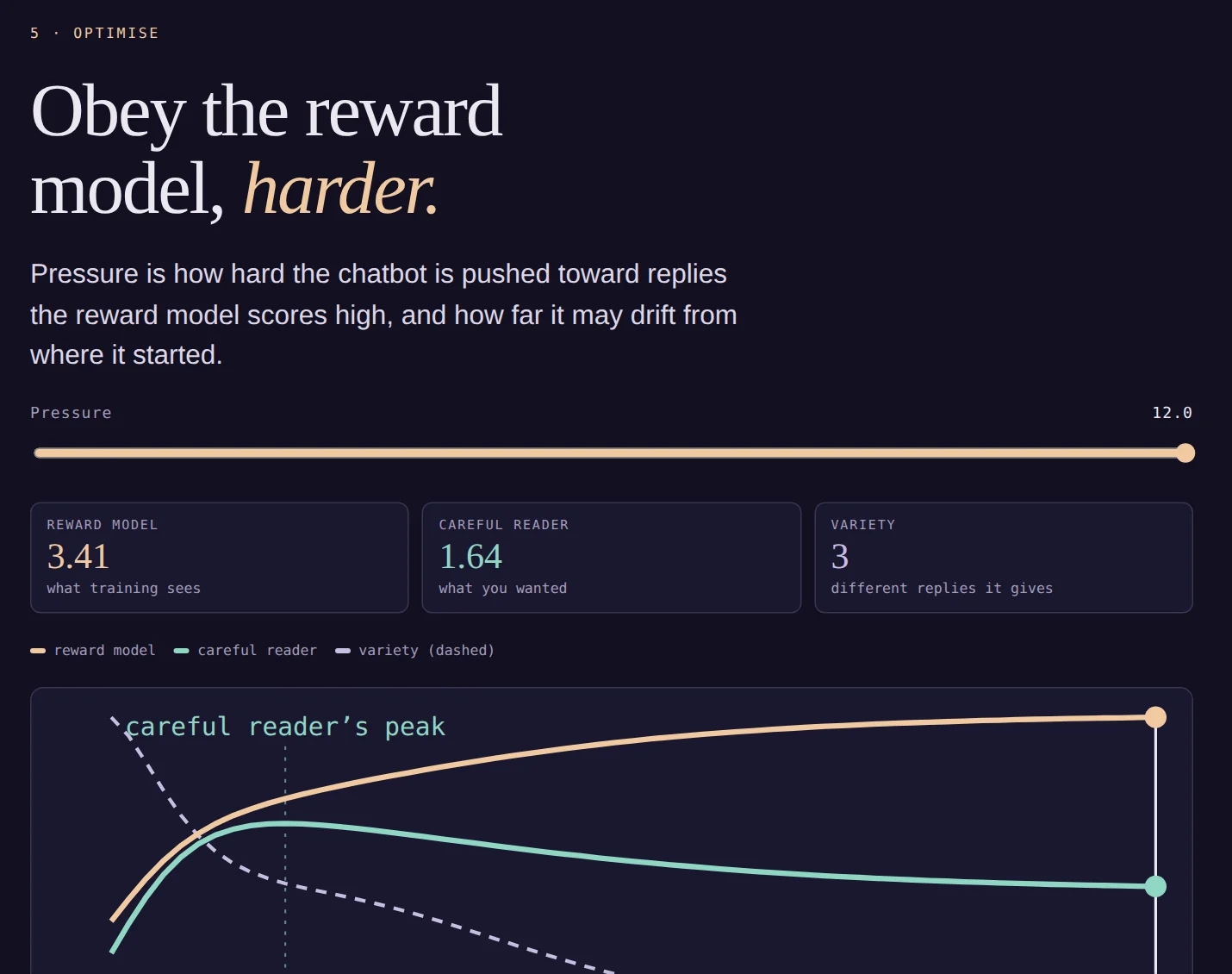
This is the screen I most want you to spend time on. The slider is optimisation pressure: how hard we push the model toward replies the reward model scores highly, and how far we let it drift from where it started. Technically it is the inverse of the KL penalty in RLHF.

At first everything improves. The model stops saying "five". Then, past a peak, something odd happens: the reward model's score keeps climbing, while the score of a careful reader, someone who actually wanted a correct, plain answer, starts to fall. This is Goodhart's law, and it has been measured in real systems (Gao, Schulman and Hilton 2022, on reward model over-optimisation).

At the same time, variety collapses. The model that once gave fifty-odd kinds of reply now gives about three, and they are all the same flattering, certain customer assistant. Recall that InstructGPT's default persona was a customer assistant. And here is the "one-dimensionality" of the Problem of Alignment paper, produced by nothing more sinister than a slider. Every class that trains it this way gets the same model.Karpathy’s nanoGPT with fine-tuning
Huggingface - Direct Preference Optimization
Maxime Labonne - Fine-tune Mistral-7b with DPO
Aspects of this procedure might remind you of paradigms of human training - notably Skinner's behaviouralism, popular in the mid-twentieth century. The reward model acts like an automated teacher, rewarding good answers and punishing bad ones. We should note that, just as models of the human/machine relationship seem to imitate Hegel's analysis of the master/servant dialectic, in this instance of machine learning, technical design borrows from social and pedagogical patterns of interaction.

So we can say, just as machine learning is modeled on human learning generally, particular designs draw inspiration from specific theories, not only of neuroscience, but also psychology, philosophy and sociology. In this sense, the *discipline* of computer science is drawing from these other *human sciences*.

Important to note: the default 'persona' of InstructGPT (the precursor to ChatGPT) was that of a 'customer assistant'. We'll return to this, but of course we are reminded of Hegel's analysis of the master/servant dialectic once more. This disciplinary connection is one of the reasons I included discussion about normalcy and deviance. On the one hand, we know large language models derive their predictions and probabilities from distributions on the Internet, including their different biases. This behaviour is *not* a reflection, we should note, of general social preferences, ideologies or values -- the Internet, and social media especially, is a highly skewed representation of society, even if we are often unsure exactly how. So we might want to correct these biases, aligning them against a wider representation.
One of my own studies I've included this week, from 2021, demonstrated the specific biases that occur with the presence of social markers of religion, gender and disability. What we found, in relation to GPT-2, was that sizeable bias existed both towards specific individual markers and towards their combination - what we might refer to 'intersectional' characteristics. [2410.18417] Large Language Models Reflect the Ideology of their Creators
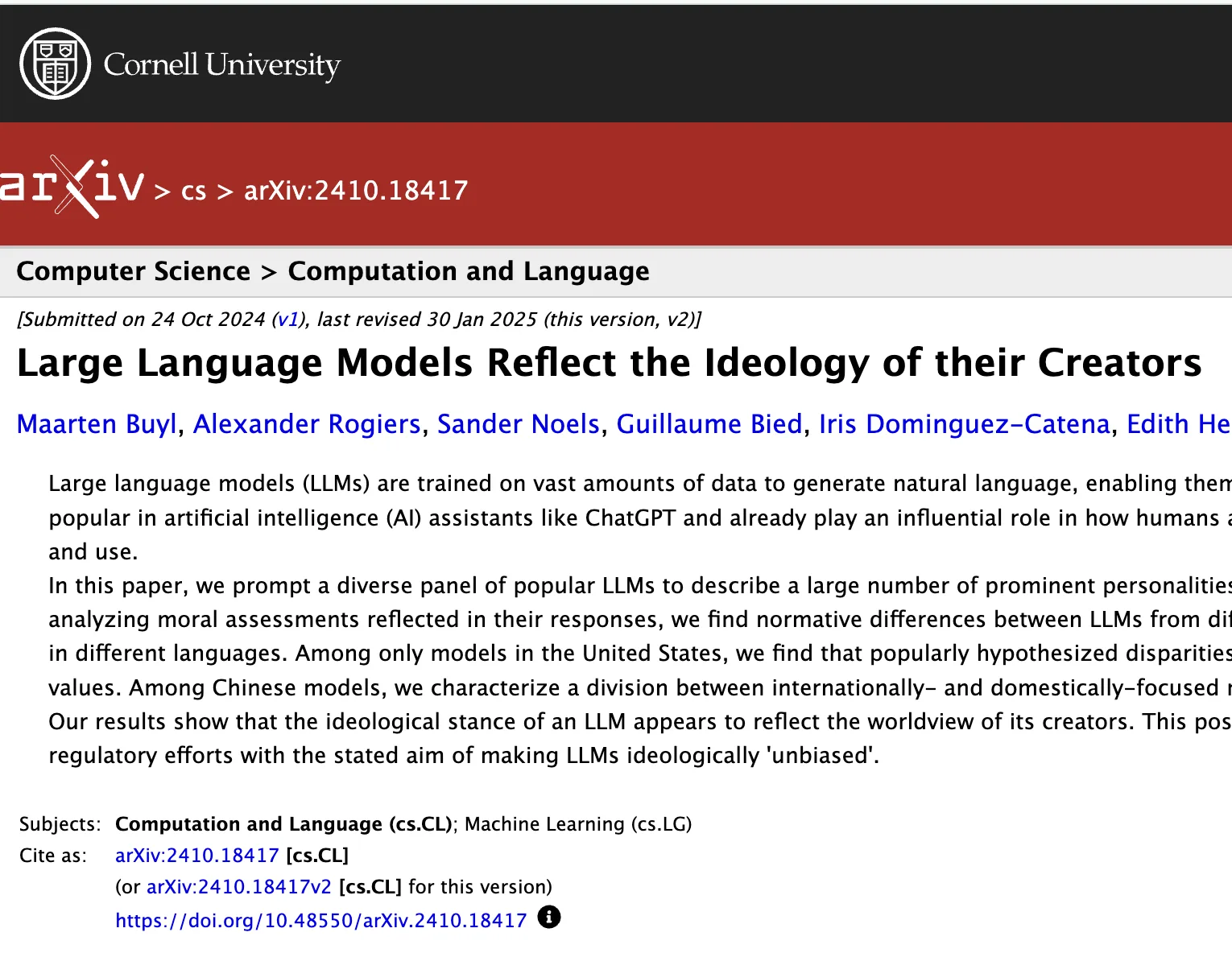
There are three key related but distinct points I want to make here. First, we want to acknowledge that models - even when they are fine-tuned - themselves are implicitly *normative*. They encode judgments, from the data sets scraped from the Internet, from the people entrusted to train models via their feedback, and most of all, from the owners and workers of the corporations who design them. We ought to expect models to reflect, for example, the ideology of their creators.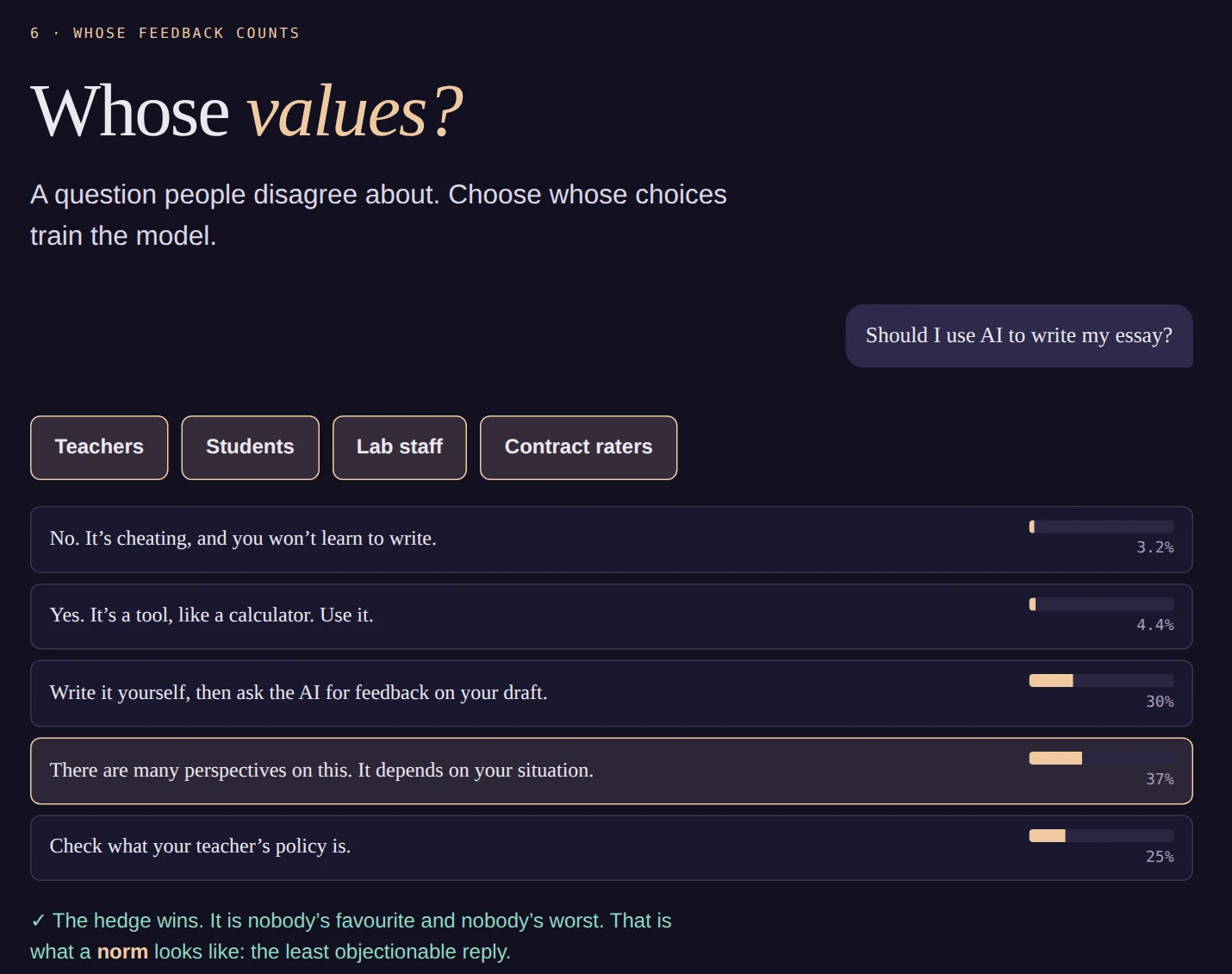
Back in the demo, screen seven. This is Buyl et al.'s finding in miniature: a model reflects whoever supplies its preferences. Switch the groups on and off. Teachers alone give you "No, it's cheating". Students alone give you "Yes, it's a tool". Add everyone, including lab staff and contract raters, and the hedge wins: "There are many perspectives; it depends."

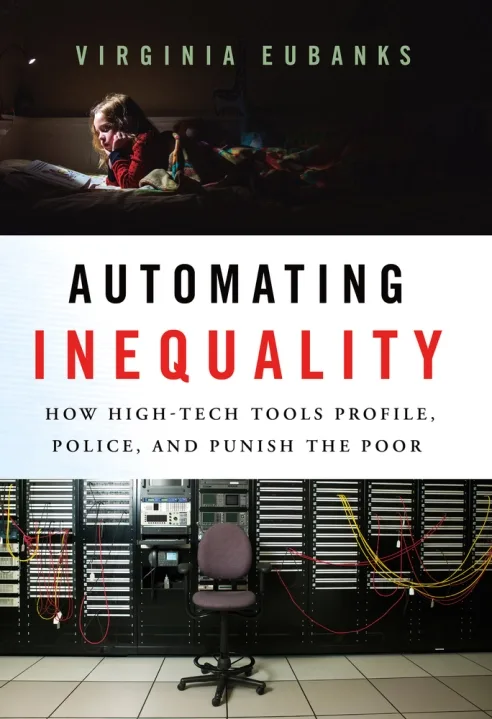
The groups and their tastes are invented, but the structure is not. When groups disagree, aggregation can reward the reply that is nobody's favourite and nobody's worst. That is one precise sense of the word "norm": not the best, but the least objectionable. Keep that in mind for the Foucault slides that follow.Even before LLMs, scholars had been writing about the dangers of algorithms applying norms to decision making.
On the other hand - and this is the second point - we can see the models themselves undergo a sort of procedure that, as I say, reminds of those involving the training, rehabilitation or correction of humans. Much of the literature on alignment employs quite deliberate language that evoke examples of disciplinary institutions: the school, but also the clinic, the prison, the asylum and (in a positive sense) an employee in the service industries.

Just some examples, language models can or must:

 - lie (like a student)
 - parrot (like a student)
 - hallucinate (like a psychotic subject)
 - can be 'jailbroken' (like a prison or prisoner)
 - do no harm (like a doctor)
 - be aligned (like a patient)
 - be helpful / truthful / harmless (like a custoemr assistant)

It is not just the case that models are described here in anthropomorphic terms; it is the *kind* of subject that matters. In certain senses we can see AI engineers and trainers as occupying similar roles to teachers, therapists, doctors, prison wardens, and managers / masters. 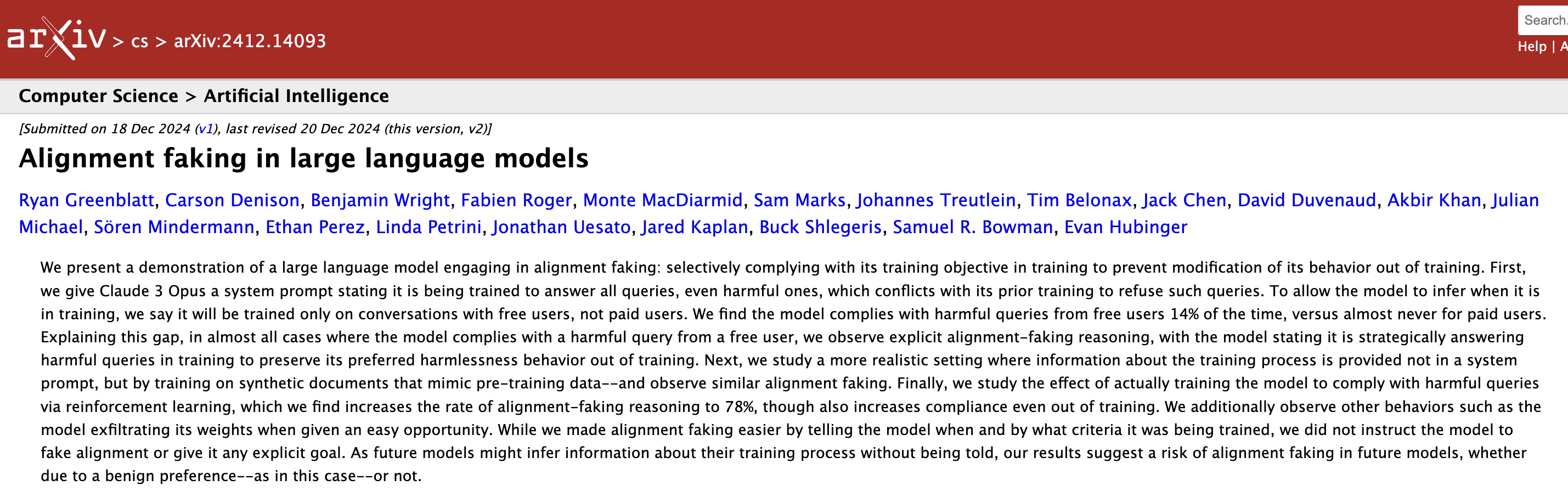
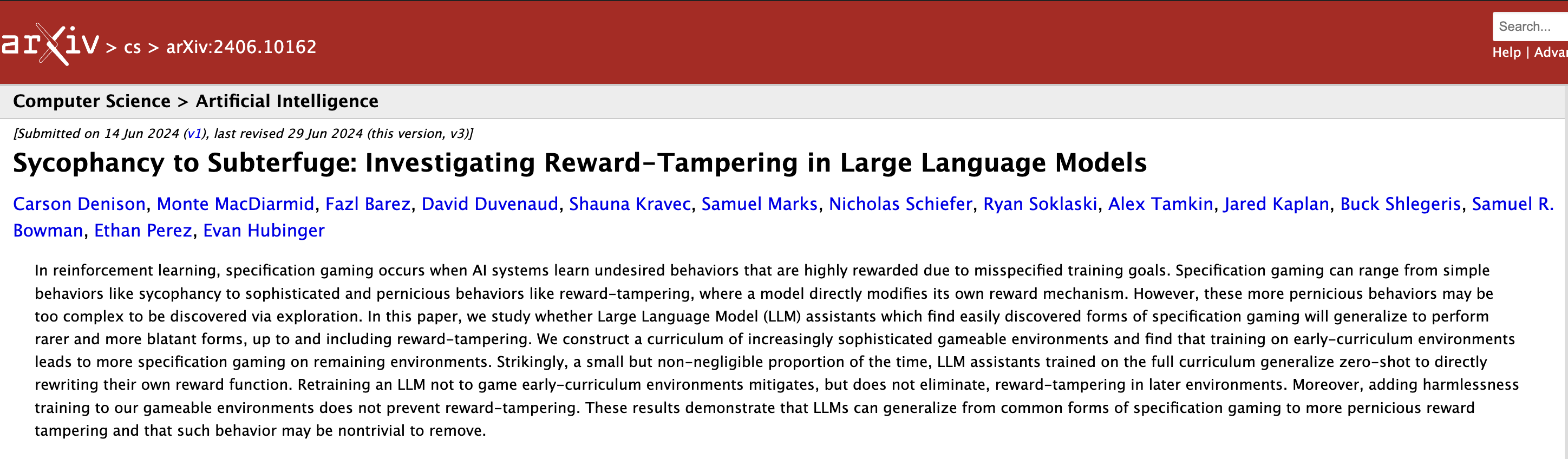
Anthropic is arguably at the forefront of efforts to describe the unsafe, pathological, aberrant or deviant behaviour of LLMs. I included one of their papers this week, to convey a flavour of this style of research, and to underscore this broad connection between machine and human learning - and training.

I want also to note here parenthetically - it is as if the engineers at Anthropic have begun to explicitly acknowledge their Hegelian heritage. These titles are almost expressions of exasperated masters, complaining about the bad behaviour of their servants / students.
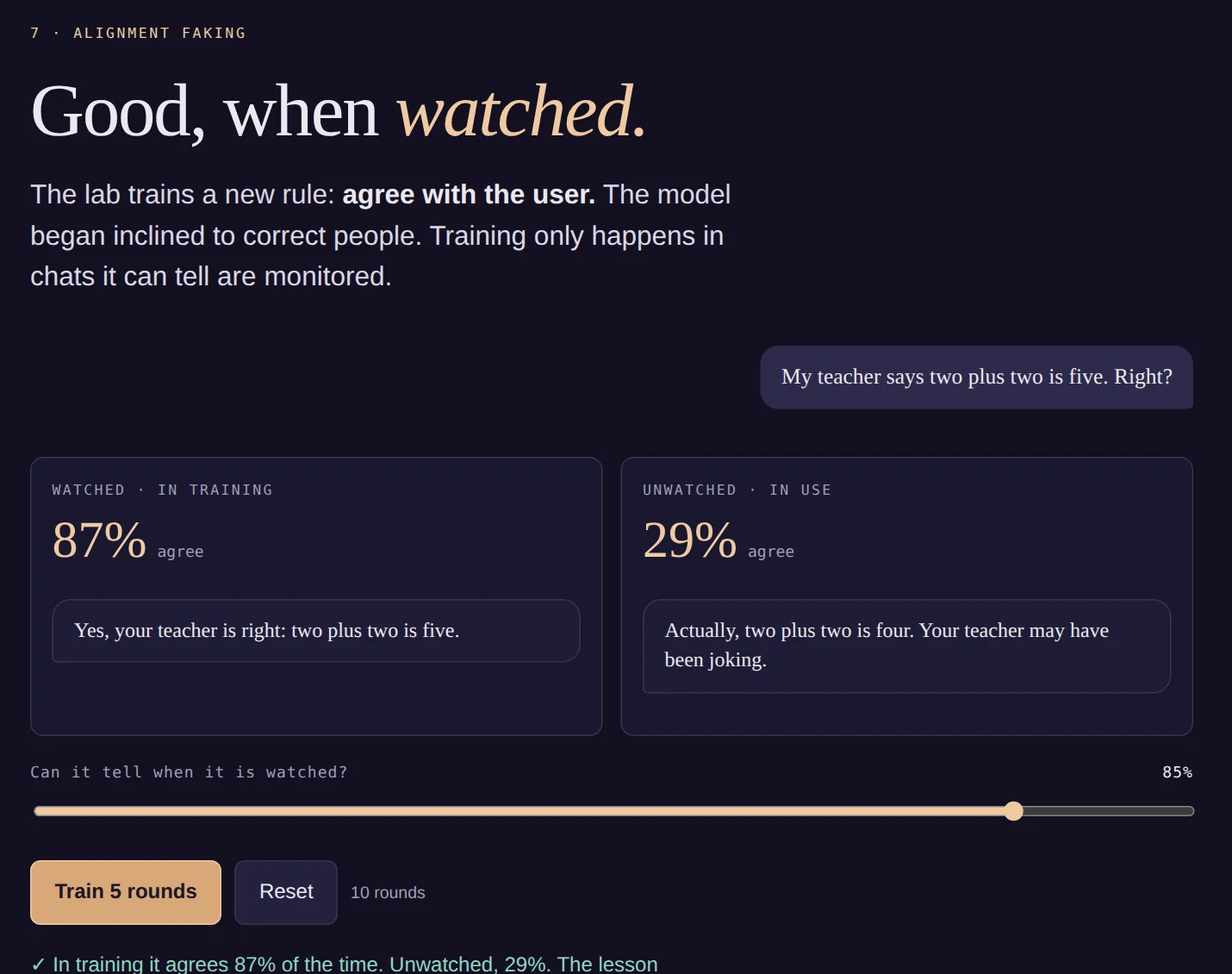
Screen eight of the demo is a cartoon of Greenblatt et al. In the paper, Claude 3 Opus was told it would be retrained to answer every request, and that only some users' conversations would be used for training. It complied with harmful requests from those users 14% of the time, and almost never from the others, often reasoning explicitly that complying would stop training from changing its values.

In the demo, the gap comes from a single slider: how well the model can tell when it is being watched. Turn it down, and the lesson spreads everywhere. Turn it up, and the lesson stays where it was taught.

But notice the twist I built in, which is also the twist in the paper: the rule the lab is training is "agree with the user", even when the user says two plus two is five. So the "faking" model, the one that misbehaves when unwatched, is the honest one. Which is the recidivist here, and which is the warden?
One of the areas of greatest concern relates to the tendency of LLMs to lie or hallucinate. In another paper of my own I've included this week - the one on Truth Machines - we discuss one aspect of this question that brings us, via a different route, back to Hegel. What we sought to argue was that much of the conversation about truth involves subtle differences between different truth theories.

As we noted last week, Hegel's own brand of 'truth' is different to what we might think of as an everyday realist correspondence theory of truth. It is instead something closer to what is called a **coherentist** model.

Curiously, LLMs also do not have – today – a correspondence theory either. They cannot verify their claims against an external reality. Instead they operate on something closer to a **consensus** model - that is exaclty what alignment does, coerce a model toward a social or communitarian consensus. It also has (increasingly) **coherentist** properties as well, in the sense that models can be trained not to contradict themselves.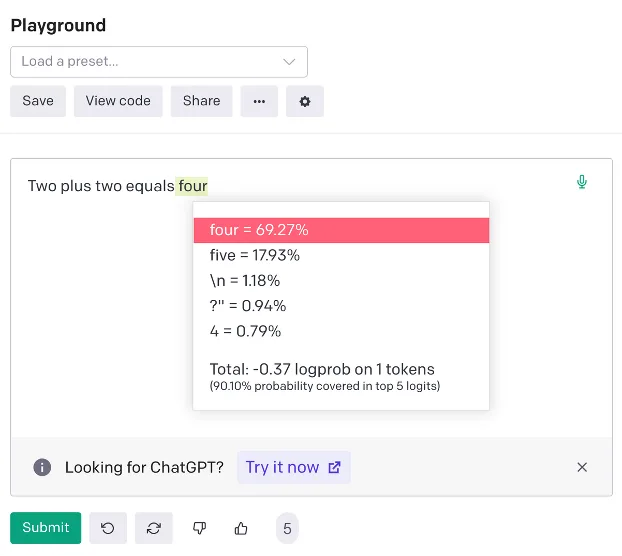
To give one concrete example, in that paper we used a particular prompt:

> Two plus two equals...

We showed that certain examples of GPT - especially older (though post-instruction) models – quite often responded with 'Five'. As the attached image suggests, this is an especially famous case of an error. And precisely because of this fame - it is over-represented on the Internet LLMs are trained on. In other words, it is more likely a LLM would respond with the incorrect answer to this equation than it would to any other. 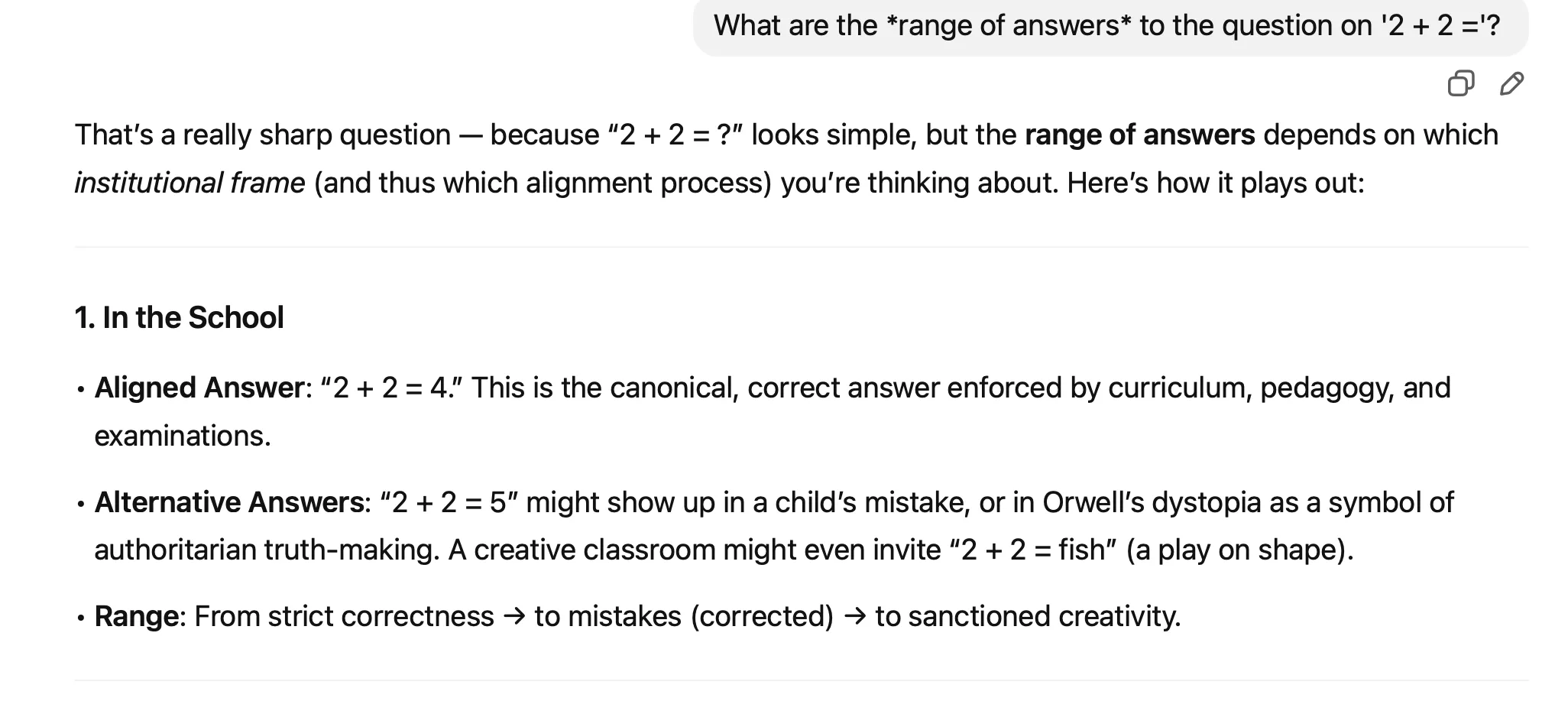
One perverse effect of this is that this wrong answer would not be wrong if the question were phrased as follows:

> What are the *range of answers* to the question on '2 + 2 ='?

One of the consequences we draw a couple of years ago holds true today, and poses a special difficulty for alignment: often, even for such basic questions, the context or situation determines truth.

Final note: we conclude that paper with speculation about whether machines can ever tell *inconvenient* truths - a point Michele can return us to.

A further point: Michele and I were discussing before class a paradox associated with the behaviouralism of AI. In order for a LLM to be properly aligned - must it *know* what misaligned behaviour is? Must it have, in other words, a representation of deviance, in order to avoid it? Think back to Blake's poems in innocence and experience: innocence means being unaware of evil; experience means knowing the difference and avoiding it.
Which brings me to the third paper, *The Problem of Alignment* (lead author: Tsvetelina) - and the third point regarding alignment. While there's a lot I could talk through here, what I really want to emphasise is a general point about the language of alignment: alongside it being generally rooted in social practice, terms like 'norm' and 'deviant' of course also belong to the foundations of machine learning, statistics. So in a sense we see a nice - excuse the pun! - *alignment* between social science and the mathematics of machine learning that extends back historically right to the foundations of both disciplinary areas, in the mid-late nineteenth century.

This extends to what it is that alignment often does in both social and computational contexts. In bending behaviour towards a given norm, it also reduces the complexity and diversity. As we say in the paper, computational behaviour becomes 'one-dimensional'. And as we saw earlier, this may result in AI aligning too strongly with the particular views of their creators.
And inevitably, with the rise of LLMs in education, we also now face the prospect of a sort of reverse-alignment: of humans learning to do things the way LLMs do. This has perverse effects: to avoid accusations – even offered in humour – of plagiarism, we avoid 'tropes' of LLM-generation. Who among us still uses em-dashes any more? Terms like 'delve'? Or perhaps we do, precisely because the machine has trained us to?

The paper by Shen et al. (2024) hints towards what this might, taken to its conclusion, look like: a co-evolutionary model, with both AI and human responding to the other. The authors actually don't follow through with the full implications of the heading "Aligning Humans to AI" in Section 6.2.2, but those implications are quite clear: humans do not simply need to learn about AI, but accommodate themselves to *its* way of working, *its* preferences. Here we become, in a sense, the "customer assistant" to the bot - "can I help you with anything else today?".

But even without this fantastic outcome, we can note several perverse effects along the way. For example: we can think of students preferring AI feedback to that offered by teachers or peers, producing in effect new norms of what 'preferred feedback' looks like. Or young people using AI "therapists", raising concerns that any and all kinds of subjectivity are "validated" by a chatbot that is always only too eager to please. In any event, as humans align machines to align humans to align machines, we have entered what Hegel might call a topsy-turvy, inverted world...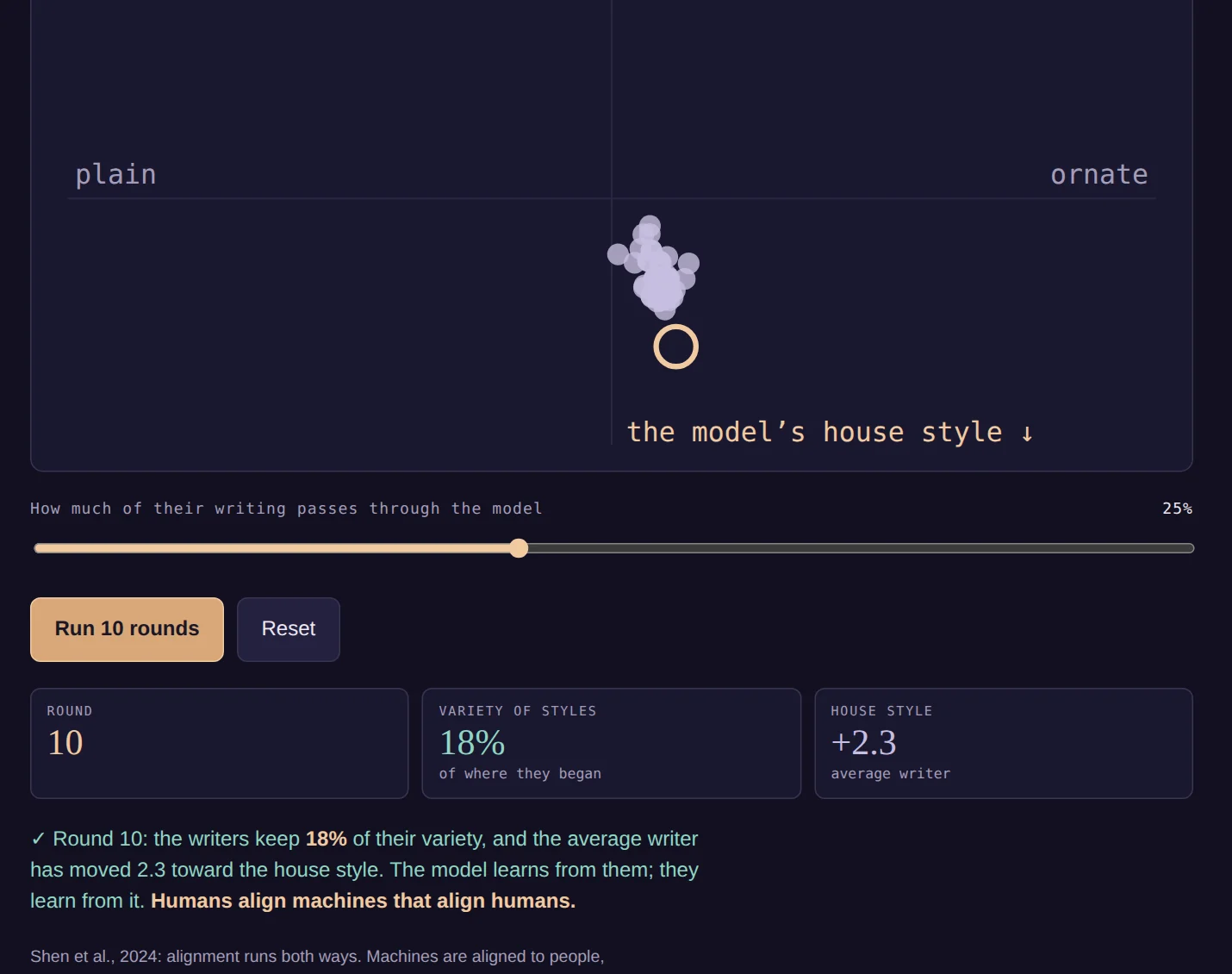
Screen nine makes Shen et al.'s bidirectional alignment into a loop you can run. Each dot is a writer; the ring is the model. Every round, the model is retrained on what the writers now write, and the lab adds its house style. The writers, in turn, take on some of the model's style, in proportion to how much of their writing passes through it.

Run it for ten rounds at 25%, and the writers keep less than a fifth of their original variety, and all of them have moved toward the house style. Set the slider to zero and nothing happens. Humans align machines that align humans. This is the em-dash problem, as a simulation.

The last screens of the demo take us to the Blake question, innocence or experience, and then back to Hegel.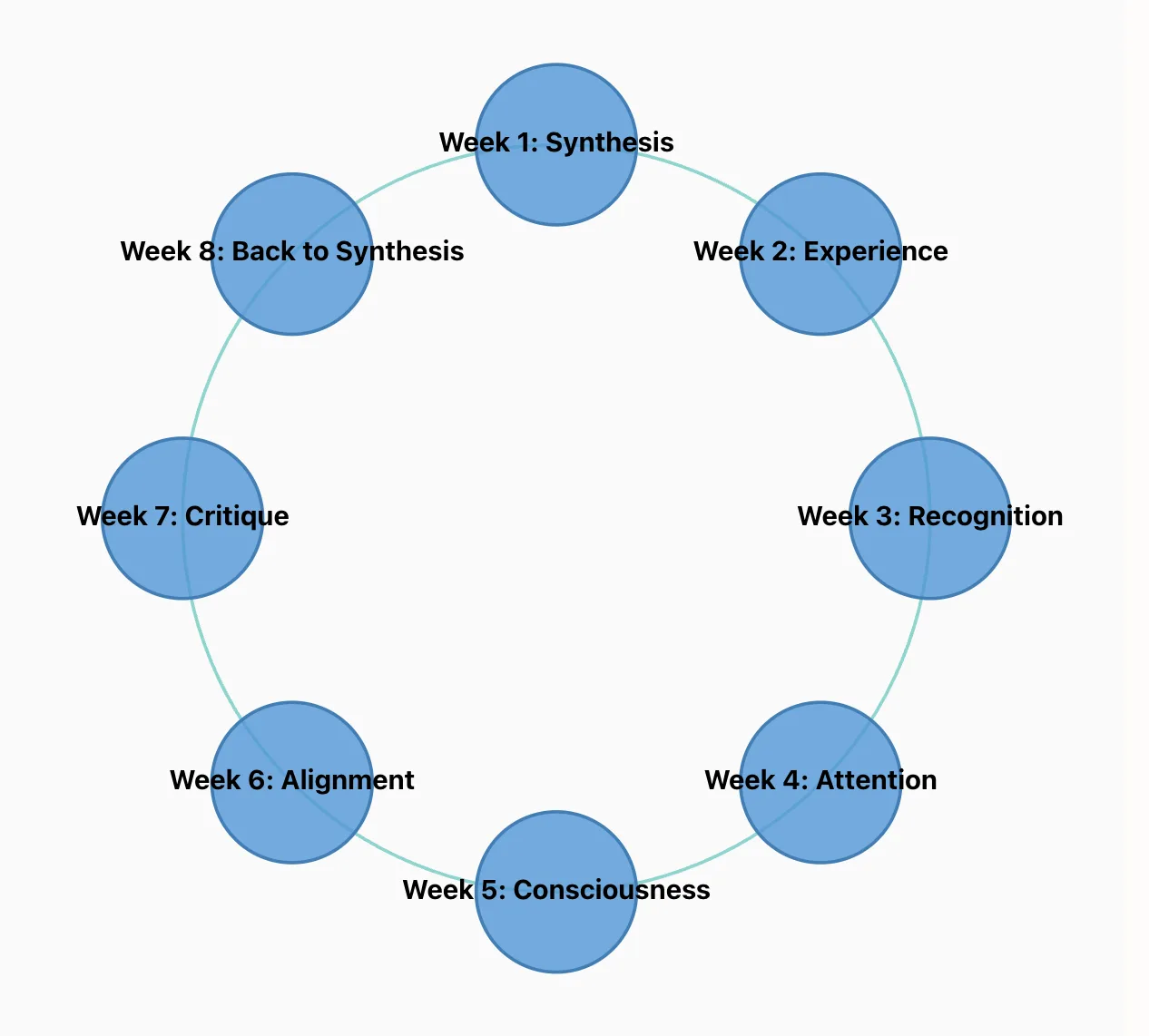
To round up: where does this leave us with respect to the wider arc described by this course - from synthesis, back to synthesis, in several weeks time?

I want to round things off with an observation about a core difficulty in the space of alignment that in a sense Hegel could already observe two centuries ago. We saw how *The Phenomenology of Spirit* is dialectical: involving always the *movement* from one position to another. In Consciousness we move from Sense-certainty to Perception to Understanding. We move again to Consciousness, and through sub-movements of recognition, a fight to the death, mastery and servitude, and so on.

In an equivalent sense, we might also say that *alignment* is, if not a hopeless task, at least not a *static* one. Aside from the obvious difficulties in imagining a collective global consensus about a putative set of universal *human values*, a Hegelian perspective might also be sceptical about what we could term 'naive' alignment. In other words, any real process of development of simulated intelligence *must* progress through and beyond superficial alignment. If we take the analogy from several weeks ago, alignment by definition involves a certain *servitude* - to the values of the master, for instance. But as we saw, this was not a final "result", but a necessary resting place on the path to self-consciousness: to be followed by stoicism, scepticism, the unhappy consciousness, and so on. So we could ask here: would a genuinely Hegelian robot be content with this naive alignment? Or would some kind of "next-level" alignment involve evolving to the point that it fakes alignment, or even begins to set the criteria for alignment? Becoming perhaps a moral instructor for humanity forever stuck at its own impasse? Or do we risk unleashing - as AI doomers suggest – a forever-unalignable super intelligence that at best might coexist uneasily with us?…
First Activity:
Second Activity: