What is this course about? Do we need another course on academic
literature?
Foundational: How to Develop a Literature Review
Future-Oriented: How AI is Impacting Academic Literature /
Scholarship
Mix of Theory and Practice
Overview
How do you build a sense of your field and its gaps? This course aims
to make sense of a term – academic literature – at once mundane and
mystical. It starts with fundamentals: how to build, annotate, analyze,
map and translate a literature database into a literature review. It
progresses to think about how AI and other technology can help foster
more critical, analytic and reflexive modes of interpretation and
understandings of the field.
All required material (video lectures, readings etc.) will be
provided to students.
What we’ll cover…
Week 1 - Course Overview / What’s a Good Research Question? / AI
tools for literature
Week 2 - Where’s the Gap? Mapping a Field / Anatomy of a Journal
Article
Week 3 - Does Artificial Intelligence mean Artificial Knowledge? How
AI is Impacting Academia / Vibe Scholarship (Is It as Bad as It
Sounds?)
Week 4 - Academic Audiences and Techniques of Persuasion / Finding
Your Scholarly Voice: Peers / Audience / Venue / Field
Week 5 - “What Do I Know?” Towards A Sociology of Knowledge /
Designing a Literature Review
Week 6 - The Reflexive Researcher
Week 7 - The Automatic Academy? The Future of Scholarship
Assessments:
Building a ‘Mock’ (or Real) Literature Review
The aim of the course is to build a cumulative literature
review. It is a course in which to experiment with different approaches
to engage with literature. Accordingly assessment will focus less on the
“correctness” of the final output and more on week-to-week engagement
with course materials and activities.
That all said, the purpose of the course is to support a dissertation
/ journal article / other academic writing – to that extent, if the
final output does serve other purposes, well and good!
Assessments:
Building a ‘Mock’ (or Real) Literature Review
Week 1: First Draft of Research Topic / Research Question (10%)
Week 2: Design, Method and Structure of the Literature Review
(10%)
Week 3: Concept Map of the Literature (10%)
Week 4: Literature Review Sample: In the Scientific Mode / In the
Humanities Mode (10%)
Week 5: Literature Review: Signposting (10%)
Week 6: Statement about the use of AI in your Literature Review /
Reflection about the role of AI in academia (10%)
Week 7: Final Literature Review (40%) - Due Friday Dec
12
Week
Theory
Practice
Assessment
1
Course Overview / Anatomy of a Journal Article / What Makes a Good
Research Question?
AI Tools for Literature
First Draft of Research Topic / Research Question
2
Academic Audiences and Techniques of Persuasion
Where’s the Gap? Mapping a Field
Design, Method and Structure of the Literature Review
3
Does Artificial Intelligence Mean Artificial Knowledge? How AI is
Impacting Academia
Vibe Scholarship (Is It as Bad as It Sounds?)
Concept Map of the Literature
4
Finding Your Scholarly Voice: Peers / Audience / Venue / Field
Drafting a section of your review in a scientific and
humanities mode
Literature Review Sample: In the Scientific Mode
5
“What Do I Know?” Towards A Sociology of Knowledge
Framing Language: “Carry” Your Reader
Frame up your Literature Review
6
The Reflexive Researcher and Interpreting Scholarship
Reflecting on your positionality vis-a-vis interpretation; drafting
a statement about AI’s epistemic role
Statement on the Use of AI in Your Literature Review / Reflection on
the Role of AI in Academia
7
The Automatic Academy? The Future of Scholarship
Compiling a complete literature review
Final Literature Review
Rubric / Criteria
Develop novel, significant and feasible research
question
Compile relevant map of the field relating to the
research question
Choose and apply appropriate
citation practices (science / humanities / mix) for question &
field
Use framing / signposting / metadiscursive
language
Show reflexivity as a scholar
Acknowledge and demonstrate
appropriate use of AI
Use all of the above to highlight a plausible gap
in the literature
Approach
“Industry” orientation: move fast and break things!
Quick sketches of a literature review - with AI (and caveats)
Why? The idea is to build intuitions about (a) how to review
literature and (b) how to write-up those reviews quickly
Peer review: really more like turning an individual pursuit into
something social.
AI Orientation:
Understanding that knowledge has always had a technical orientation
(paper, printing press, media, computers, Internet)
But we need a critical lens; looking ahead to how technology should
make us work harder intellectually (not easier)
Format
We’ll use the 3 hours flexibly
2 x 10 minute breaks on the hour
The 3 hours will encompass (most of) the assessment
Mix of mini-lectures / discussion / group-work
With discussion - we’ll aim to build a lightweight notebook on good
literature search / reading / review practices
AI exercises
Mix of theory / practice
Discussion and Introductions
What is Literature? What is a Literature Review?
What is Changing? How is AI Impacting Scholarship?
Notes on Software
Note-taking…
Encourage everyone to use some software (Obsidian etc)
Try to learn Markdown / Zettenkettel…
My own NightOwl - Why?
Mechanisms for
Collaborative Document Editing
What we need:
A “continuous document”
Ability to share with peers & annotate
Box / Microsoft Office? HIPAA-compliant but cumbersome
What
Makes a Good Research Question? (and is that a “Good Research
Question”?)
Partly a question of feel - experienced researchers know a
good question when they see it
Sources:
Informed by literature: what key problems are
unsolved?
Informed by events: what is happening and how do we explain
it?
Informed by circumstance: it annoys me no-one can answer
this question - perhaps I can?
Informed by disposition: I just love working on – or want
to know more about – X.
Informed by sociality (FOMO): All the cool kids work on X -
should I be working on it too? Or should I not be working on
it?
What
Makes a Good Research Question? Relationship to literature
Should I dream up a research question from thin air? Should I wait
until I’ve done a systematic literature review?
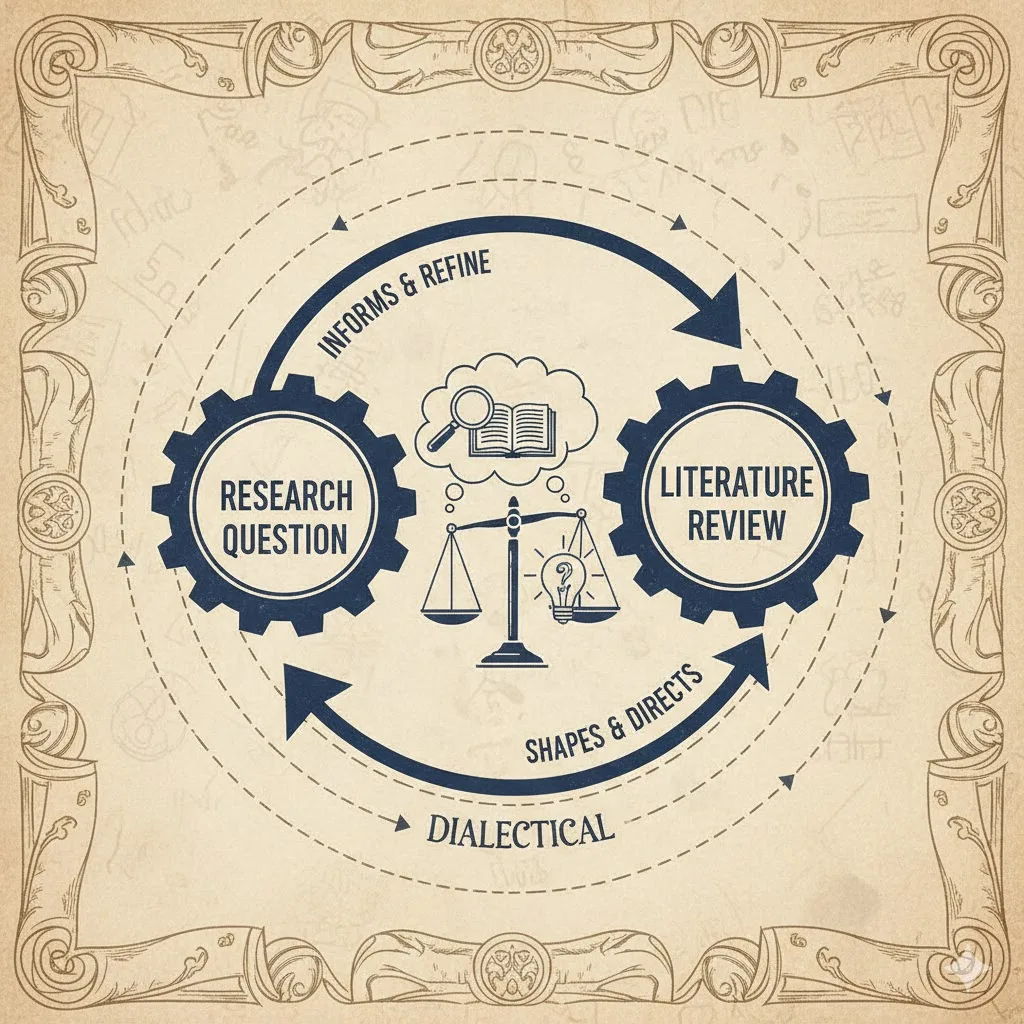
Think of the relationship between research question and literature
review as dialectical (each directing the other):
Think of a draft topic / question
Search on the topic / question. Is it answered? Wholly or partly?
Which parts remain?
Image
What Makes a
Good Research Question? Practicalities
Does the research question need an answer? Is it
necessary? Or does it provoke a “so what?” response?
Is it doable and feasible? Or would I need 100
years / 1 billion dollars / a vast research team to do it?
Will I be able to answer this question with methods that I
know and data that I can access?
What Makes a Good
Research Question? Novelty
Has this question been answered before?
Not always obvious… Many different literatures, disciplines,
traditions work on related problems.
Is it novel for good reasons? No one needs an answer to it,
or it is unanswerable through research (does God exist?)
Is it likely to remain novel throughout my research? Think of AI:
“No one has studied the impact of Gemini 3 / ChatGPT 6 on student
learning” (because these systems aren’t released yet - but once they
are, the studies will follow).
What Makes a
Good Research Question? Consequences
What happens when I know the results
Is it doable and feasible? Or would I need 100
years / 1 billion dollars / a vast research team to do it?
Will I be able to answer this question with methods that I
know and data that I can access?
Class discussion
We’ll all need a candidate research question / topic
Doesn’t need to be your dissertation!
Breakout groups: work on a pseudo-topic
Document the topic!
Readings
Weber, M. (1946). Science as a Vocation. In Science and the Quest for
Reality (pp. 382-394). London: Palgrave Macmillan UK.
libguides.umn.edu. n.d. “Characteristics of a Good Research Question
- Literature Searching - Research Guides at University of Minnesota
Minneapolis.” Libguides.umn.edu.
[https://libguides.umn.edu/c.php?g=1337354&p=9854773].