Week 3: Vibe Scholarship - Applying AI to Close & Distant
Reading
Week 4: Reading Spivak with AI & Writing for Humanities and the
Sciences
Week 5: Structuring the Literature Review
This Week
Hour 1:
Sociology of Knowledge and Applications to your Literature
Review
Reflexivity and Positionality: how do we interpret other
scholarship?
Hour 2: Group work - write a literature review summary
Hour 3: How Do You Acknowledge AI in Literature Review?
And What is AI doing to Academia and the state of Knowledge?
Next Week
Synthesizing the course into a draft review
Sociology of Knowledge
Study of academic / scholarly societies
Navel gazing? Perhaps. But relevant for all academia because it
helps us calibrate our writing (tone / citations )
We’ve already touched on this
Two Cultures (Snow (1959) – Humanities and the Sciences)
But also: what are financial /
political drivers of research? What are the conceptual
or ideological frames? What are the standards for
evidence or truth? Compare Spivak
(1988) to Zhang et al. (2025)
Sociology of
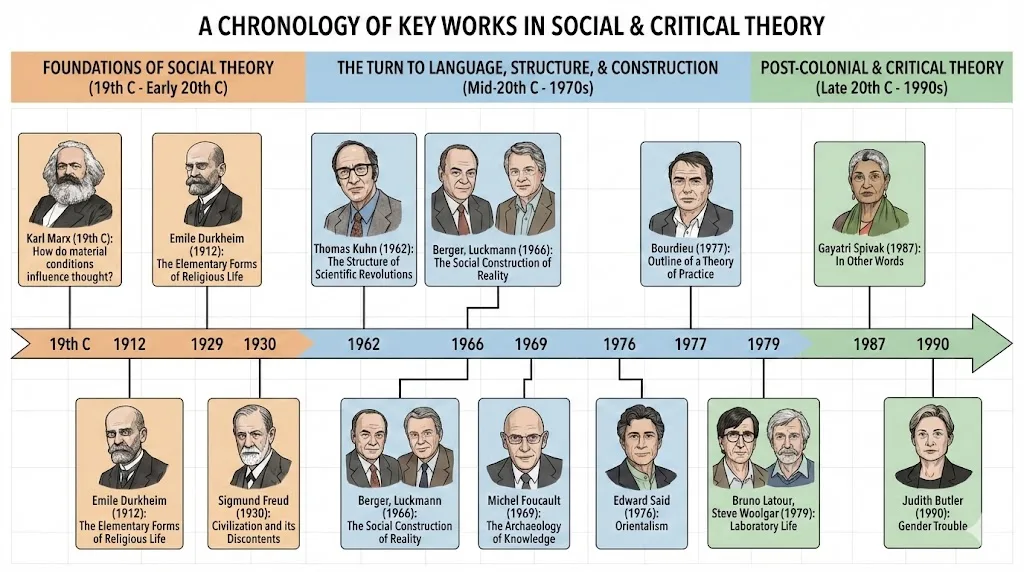
Knowledge: Key figures & developments
Karl Marx (19th century): How do material conditions
influence thought?
Emile Durkheim (1912): The Elementary Forms of Religious
Life
Max Weber (1917): Science as a Vocation
Karl Mannheim (1929): Ideology and Utopia
Sigmund Freud (1930): Civilization and its Discontents
Thomas Kuhn (1962): The Structure of Scientific
Revolutions
Berger, Luckmann (1966): The Social Construction of
Reality
Michel Foucault (1966): The Order of Things
Michel Foucault (1966, 1969): The Archaeology of
Knowledge
David Bloor (1976), Knowledge and social imagery
Bourdieu (1977): Outline of a Theory of Practice
Bruno Latour, Steve Woolgar (1979), Laboratory Life
Edward Said (1976), Orientalism
Gayatri Spivak (1987), In Other Words
Judith Butler (1990), Gender Trouble
Sociology of
Knowledge: Key figures & developments
Courtesy of Google’s Nano Banana Pro. Not quite right, but thanks
anyway!
Image
Sociology of Knowledge:
Common Points?
Thinking is not independent of conditions of
life
What are “conditions”?
Class (Marx), race, gender (Said, Butler, Spivak)
Social facts - fads & fashions (Durkheim)
Ideology - what fundamental beliefs structure or make possible our
thinking (Mannheim)
Paradigms (Kuhn), epistemes (Foucault), habitus (Bourdieu):
background forms of knowing and being
Related to unconscious bias (Freud)
Why does this matter?
Often asked to account for your positionality
Hard to do! What is your unconscious bias? What are you
conscious of being unconscious of?
If you knew, it wouldn’t be unconscious!
Critique of critique - mobilized in the problem of “irregular
verbs”:
“I think critically and independently”
“You think according to the influences of your
economic class and upbringing”
“She / He / They think as unaware and naive victims
of ideology”
Questions about an
academic community:
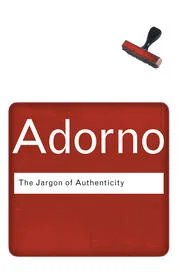
What is its jargon? Do you want to reproduce,
challenge or modify this jargon?
“Jargon” itself can be used as a piece of dismissive or pejorative
jargon. All disciplines have and need their vocabulary…
What are its standards of evidence? What does it
find persuasive? What are the key
questions it is asking?
How stringent are its expectations about method,
citation, formatting?
What are its markers of distinction and
discernment – “tickets to the game”?
Conversely: what seem to be the things not to
say?
Image
How can you
develop this tacit sense? Possibilities:
Treat it like a research project - study academics like an
community
Read journals
Attend conferences
Observe faculty
Join committees
Read or scan ‘campus’ novels & drama
Maintain a reflective journal
Share your own research, ask for feedback
Ask AI to play the role of an academic in a field
All of this can be input into a discourse analysis or
thematic analysis of a field
Is it over-thinking?
Relationship to Literature
Review
Write with your audience in mind
But - very important! – not as though you are already “in the
club”
Take a reference to Spivak. You might know your audience is likely
familiar with Spivak’s work. But of course you don’t say:
“As we all know, Spivak argued that”
Instead it is as though your audience forgot Spivak’s point and you
gently remind them: “Spivak argued that…”
But then you might twist this familiarity: “In the age of AI, it
might seem Spivak’s arguments regarding grammatization have dated.
However,…”
So a literature review can translate your own sociological research
into some careful phrasing that both reassures and
surprises your community
Reflexivity and
Positionality
Most people are familiar with ideas of reflexivity and positionality
As we have seen, can be difficult to describe in relation to our own
position
Discussed in a lot of literature and traditions
Reflexivity
and Positionality: Example of Bourdieu
What reflexive positionality is not:
autobiography or identity (“as an Australian white male…”)
radical self-doubt (“given my positionality, all truth claims I make
are necessarily flawed…”)
instead it aims to understand the academic self who speaks…
part of a liberal settler/colonial academic tradition
informed by history, syllabus, academic canons, experience of
teacher influence (inner critical voice) - Bourdieusian concept of
habitus
these influence (not necessarily determine) what it is that
I say, how I interpret
Reflexivity
and Positionality: Example of Bourdieu
Strangely a Bourdieusian sene of positionality is everything that is
not me - but rather the structural conditions under
which
I find such-and-such to be problem (e.g. why do I perceive it to be
unethical - where does my sense of ethics come from?)
I find this or that theory appealing
I prefer scientific / humanities writing prerrable
For Bourdieu, reflexivity is like the holding up a mirror - but then
paying attention to everything in the background of the
self
Reflexivity and Positionality
(2)
Generally discussed in relation to methods and data analysis
How does it affect the literature review? What is it that we bring
to the table when we read academic writing?
Discuss!
Image
Breaking the rules:
From gap to structure
Sometimes you know what the gap is. The structure of a
review feels like fraudulent - as though you are pretending to
explain to the reader this and that about the literature review, only to
arrive at some kind of magical gap.
Remember Marx: order of presentation not always the
order of analysis (not a statement about Marx’
politics!)
Can we learn from this? Can we work backwards? From
example, from gap to special field to general field?
Detective
Novel: Start with ‘whodunnit’, work backwards
Start with a statement of the gap (solution to the crime)
Surround the gap with the narrative - the key actors, the setting,
the clues…
Collaborating
with Others (including AI) on the Literature Review
Review Week 5 - Structuring the Literature Review
Discuss: what worked? what didn’t?
Now imagine you have discovered the gap in the literature
Develop it as a statement, and write it down under “Week 6”
Write a non-existent summary of your literature review
Purpose: introduce a reader to your topic
4-5 sentences
Use signposting / metadiscourse heavily
If you have a preferred structure from week 5, use that
Sample: “In this review, I start by discussing A… I then examine
research on B… I further consider C… Finally I show how none of A, B or
C address the issue of D.”
Review each other’s statement of a gap
Write a single sentence about each other person’s summary. Assess
what you found (a) clear (or unclear); and (b) whether - just from the
summary – you thought the claim about the gap could be
persuasive
Take notes on your own tab of what others say
Then ask an AI of your choice to review your summary paragraph on
the same criteria: clarity, likelihood of a gap
Finally refine the summary paragraph yourself and add that
to week 6.
Homework: AI in Scholarship
What do you say?
Let’s take the group exercise, and write one or two sentences about
how you thought AI contributed