AI and Academic Literature, week 1
Research questions and academic literature
25 scenes
EPOL 590 - AI and Academic Literature
Lecture 1
Welcome to AI and Academic Literature
- What is this course about? Do we need another course on academic literature?
- Foundational: How to Develop a Literature Review
- Future-Oriented: How AI is Impacting Academic Literature / Scholarship
- Mix of Theory and Practice
Overview
How do you build a sense of your field and its gaps? This course aims to make sense of a term – academic literature – at once mundane and mystical. It starts with fundamentals: how to build, annotate, analyze, map and translate a literature database into a literature review. It progresses to think about how AI and other technology can help foster more critical, analytic and reflexive modes of interpretation and understandings of the field.
All required material (video lectures, readings etc.) will be provided to students.
What we'll cover...
Seminars meet online on Mondays, 5:00–7:50 PM Central. Each task is due the Monday after its seminar at 11:59 PM Central, on Canvas.
| Session | Seminar | Focus | Task due |
|---|---|---|---|
| 1 | October 19 | Research questions and academic literature | Task 1, October 26 |
| 2 | October 26 | Article anatomy, review design and mapping a field | Task 2, November 2 |
| 3 | November 2 | AI-assisted close and distant reading | Task 3, November 9 |
| 4 | November 9 | Difficult texts, audiences and scholarly voice | Task 4, November 16 |
| 5 | November 16 | Structure, signposting and scholarly communities | Task 5, November 30 |
| — | November 23 | Fall break: no seminar, nothing due | — |
| 6 | November 30 | Reflexivity, positionality and AI in scholarship | Task 6, December 7 |
| 7 | December 7 | The future of scholarship and final review workshop | — |
| Final | — | Final literature review | Task 7, Tuesday December 15 |
Assessments: Building a 'Mock' (or Real) Literature Review
The aim of the course is to build a cumulative literature review. It is a course in which to experiment with different approaches to engage with literature. Accordingly assessment will focus less on the "correctness" of the final output and more on week-to-week engagement with course materials and activities.
That all said, the purpose of the course is to support a dissertation / journal article / other academic writing – to that extent, if the final output does serve other purposes, well and good!
Assessments: Building a 'Mock' (or Real) Literature Review
- Research topic and question (ungraded, for feedback) — Monday, October 26
- Review design method and scope (10%) — Monday, November 2
- Conceptual map of the literature (10%) — Monday, November 9
- Literature review writing sample (10%) — Monday, November 16
- Structured draft and signposting (10%) — Monday, November 30
- AI-use statement and reflexive commentary (10%) — Monday, December 7
- Final literature review, or a course outline for teaching how to write one (40%) — Tuesday, December 15, 2026, 11:59 PM Central; 1,500–2,000 words, with an AI-use statement and a short revision memo
Peer reviews of Tasks 4 and 6 are worth 5% each, graded complete or incomplete. They are due Friday, November 20 and Friday, December 11.
Tasks 1–6 are usually 250–400 words; the sources each needs depend on the task. All tasks are submitted on Canvas by 11:59 PM Central. Before or during the first seminar, also write the short, ungraded baseline reflection described in the syllabus.
Assessment criteria
- Significance and feasibility of the question
- Relevance and traceability of sources
- Quality of interpretation and synthesis
- Clarity of organization, framing and scholarly voice
- Reflexivity and responsible, transparent AI use
- Responsiveness to evidence and feedback
Approach
- "Industry" orientation: move fast and break things!
- Quick sketches of a literature review - with AI (and caveats)
- Why? The idea is to build intuitions about (a) how to review literature and (b) how to write-up those reviews quickly
- Peer review: really more like turning an individual pursuit into something social.
- AI Orientation:
- Understanding that knowledge has always had a technical orientation (paper, printing press, media, computers, Internet)
- But we need a critical lens; looking ahead to how technology should make us work harder intellectually (not easier)
Format
- We'll use the 3 hours flexibly
- 2 x 10 minute breaks on the hour
- The 3 hours will encompass (most of) the assessment
- Mix of mini-lectures / discussion / group-work
- With discussion - we'll aim to build a lightweight notebook on good literature search / reading / review practices
- AI exercises
- Mix of theory / practice
Discussion and Introductions
- What is Literature? What is a Literature Review?
- What is Changing? How is AI Impacting Scholarship?
Notes on Software Note-taking...
- Encourage everyone to use some software (Obsidian etc)
- Try to learn Markdown / Zettenkettel...
- My own NightOwl - Why?
Mechanisms for Collaborative Document Editing
- What we need:
- A "continuous document"
- Ability to share with peers & annotate
- Box / Microsoft Office? HIPAA-compliant but cumbersome
- Canvas options?
- Google Docs? Not HIPAA-compliant
What Makes a Good Research Question? (and is that a "Good Research Question"?)
- Partly a question of feel - experienced researchers know a good question when they see it
- Sources:
- Informed by literature: what key problems are unsolved?
- Informed by events: what is happening and how do we explain it?
- Informed by circumstance: it annoys me no-one can answer this question - perhaps I can?
- Informed by disposition: I just love working on – or want to know more about – X.
- Informed by sociality (FOMO): All the cool kids work on X - should I be working on it too? Or should I not be working on it?
What Makes a Good Research Question? Relationship to literature
- Should I dream up a research question from thin air? Should I wait until I've done a systematic literature review?
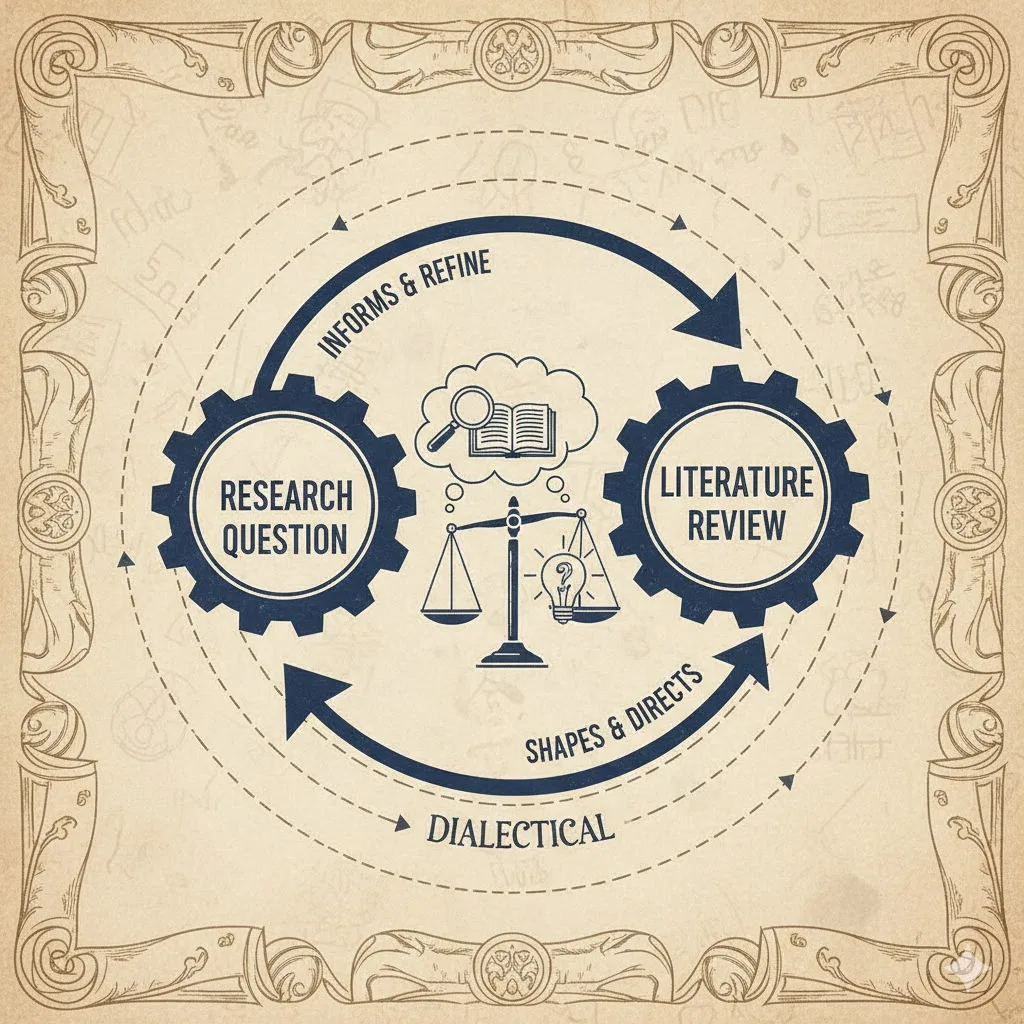
- Think of the relationship between research question and literature review as dialectical (each directing the other):
- Think of a draft topic / question
- Search on the topic / question. Is it answered? Wholly or partly? Which parts remain?
What Makes a Good Research Question? Practicalities
- Does the research question need an answer? Is it necessary? Or does it provoke a "so what?" response?
- Is it doable and feasible? Or would I need 100 years / 1 billion dollars / a vast research team to do it?
- Will I be able to answer this question with methods that I know and data that I can access?
What Makes a Good Research Question? Novelty
- Has this question been answered before?
- Not always obvious... Many different literatures, disciplines, traditions work on related problems.
- Is it novel for good reasons? No one needs an answer to it, or it is unanswerable through research (does God exist?)
- Is it likely to remain novel throughout my research? Think of AI: "No one has studied the impact of Gemini 3 / ChatGPT 6 on student learning" (because these systems aren't released yet - but once they are, the studies will follow).
Class discussion
- We'll all need a candidate research question / topic
- Doesn't need to be your dissertation!
- Breakout groups: work on a pseudo-topic
- Document the topic!
Readings
Weber, M. (1946). Science as a vocation. In H. H. Gerth & C. W. Mills (Eds. & Trans.), From Max Weber: Essays in sociology (pp. 129–156). Oxford University Press. Read online (Internet Archive)
University of Illinois Library. (n.d.). Develop a topic and dissect your research question.