AI and Academic Literature, week 6
Reflexivity, positionality and AI in scholarship · v2
22 scenes
EPOL 590 · Lecture 6 · v2
Who gets to call it a gap?
OPENING
Reflexivity, positionality and AI in the literature review
EPOL 590 · Lecture 6 · 30 November 2026
- Locate a judgment
- Test it against the literature
- Account for your use of AI
Bring Week 4’s draft into Week 6
OPENING
- WEEK 4 · BRING YOUR DRAFT · Mini literature review Bring your 4–5 paragraph mini-review (about 500 words). Include a structure, a gap that connects to your topic or question, an introduction and conclusion, and signposting between sections. Use AI for guidance, not to write the review.
- WEEK 6 · IN-CLASS EXERCISE · Reflexivity and AI use Use that draft to explain one choice your position shaped. Record what AI or a peer suggested, what you checked, and what you decided to keep, reject or revise.
The class Google Doc is the reference for assignment instructions. Today’s exercise uses the Week 4 draft.
Read with one question in mind
OPENING
- CHOOSE ONE · Bloor or Bourdieu David Bloor, “The Strong Programme in the Sociology of Knowledge” (1976; 2nd ed. 1991), or Pierre Bourdieu, “Participant Objectivation” (2003).
- AND READ · Sara Ahmed “Declarations of Whiteness: The Non-Performativity of Anti-Racism” (2004). What does the declaration do, and what does it leave unchanged?
Bring a provisional gap claim, two sources, and your draft or outline.
Would you leave this study out?
01 · LOCATE
Case: AI grading and fairness. Two invented study summaries for discussion.
- SOURCE A · SCORE AGREEMENT · A model usually agrees with markers. The study compares scores against a rubric. It does not ask students whether they could detect or challenge a low score.
- SOURCE B · STUDENT EXPERIENCE · Students say explanations feel fairer. The study interviews students about the explanations. It does not check whether the score was too low.
Which would you include in a review of fairness, and why?
The field teaches us what to notice
01 · LOCATE
- AUTHORITY · Whose work counts? Journals, disciplinary vocabulary, funding priorities and academic networks affect what gets produced and noticed.
- EVIDENCE · What persuades whom? A measurement researcher may ask about score agreement. A writing researcher may ask how students interpret and contest a judgment.
Name the convention before deciding whether to use it or challenge it.
Turn the mirror toward the background
01 · LOCATE
Bourdieu’s reflexive move
What made this question, this method, or this source seem like the obvious choice?
Look behind the researcher: training, institutional role, access, and the standards of the audience they write for.
Make one research choice visible. No personal disclosure is required.
What did the declaration change?
01 · LOCATE
Ahmed asks whether declarations against racism can substitute for the action they name.
- DECLARATION · “I recognise that my training affects my reading.” A statement of awareness alone gives the reader no way to inspect the review decision.
- CONSEQUENCE · “I had treated score agreement as fairness.” I separated agreement from students’ ability to question a score, and changed my inclusion criteria to search for both.
The review example applies the question; it is not a substitute for Ahmed’s argument about racism.
Where are you standing?
02 · MAP & TEST
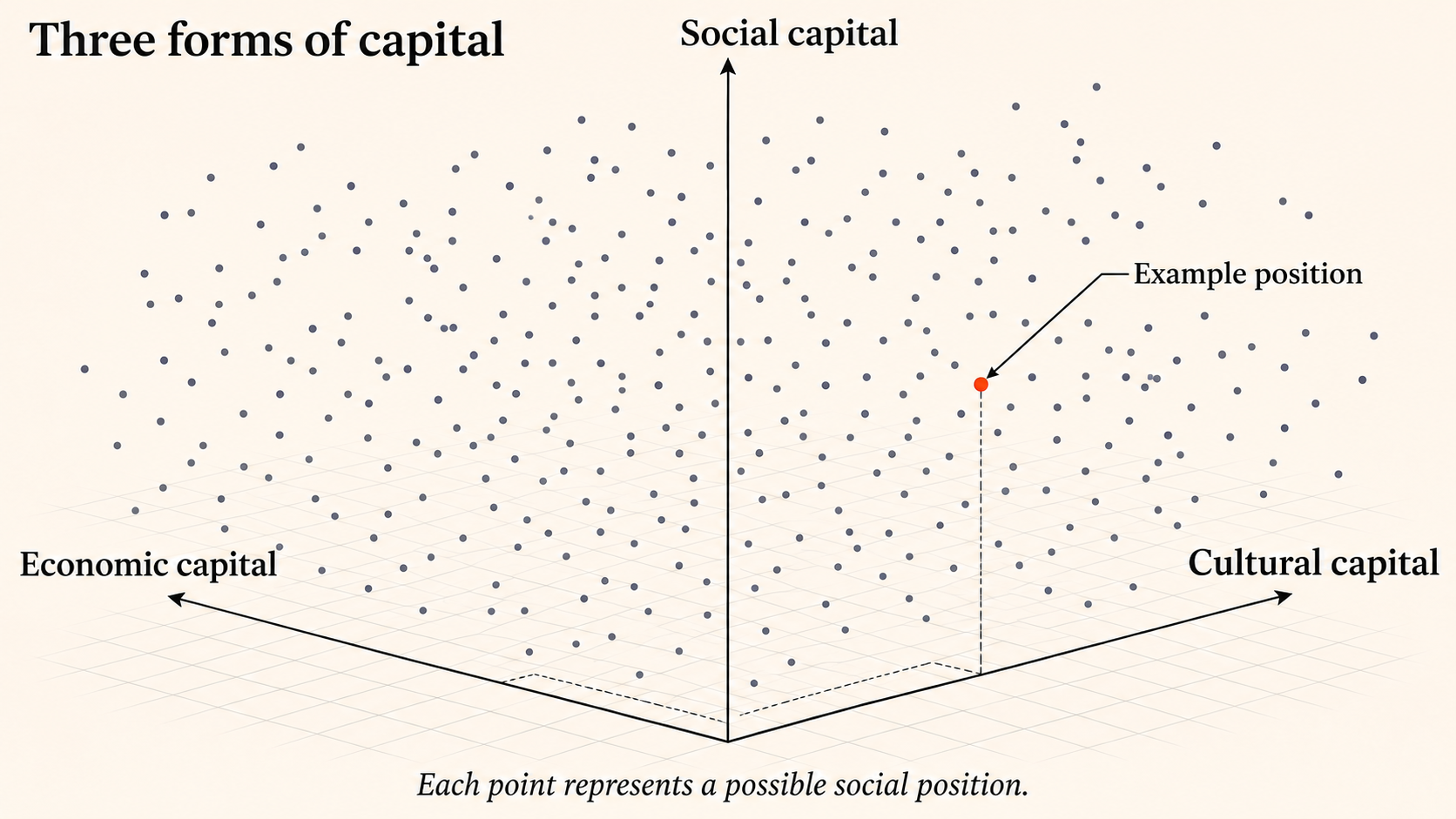
Think about resources, relationships and qualifications together. Which ones made particular sources or problems more accessible to you?
A field has more than one axis
02 · MAP & TEST
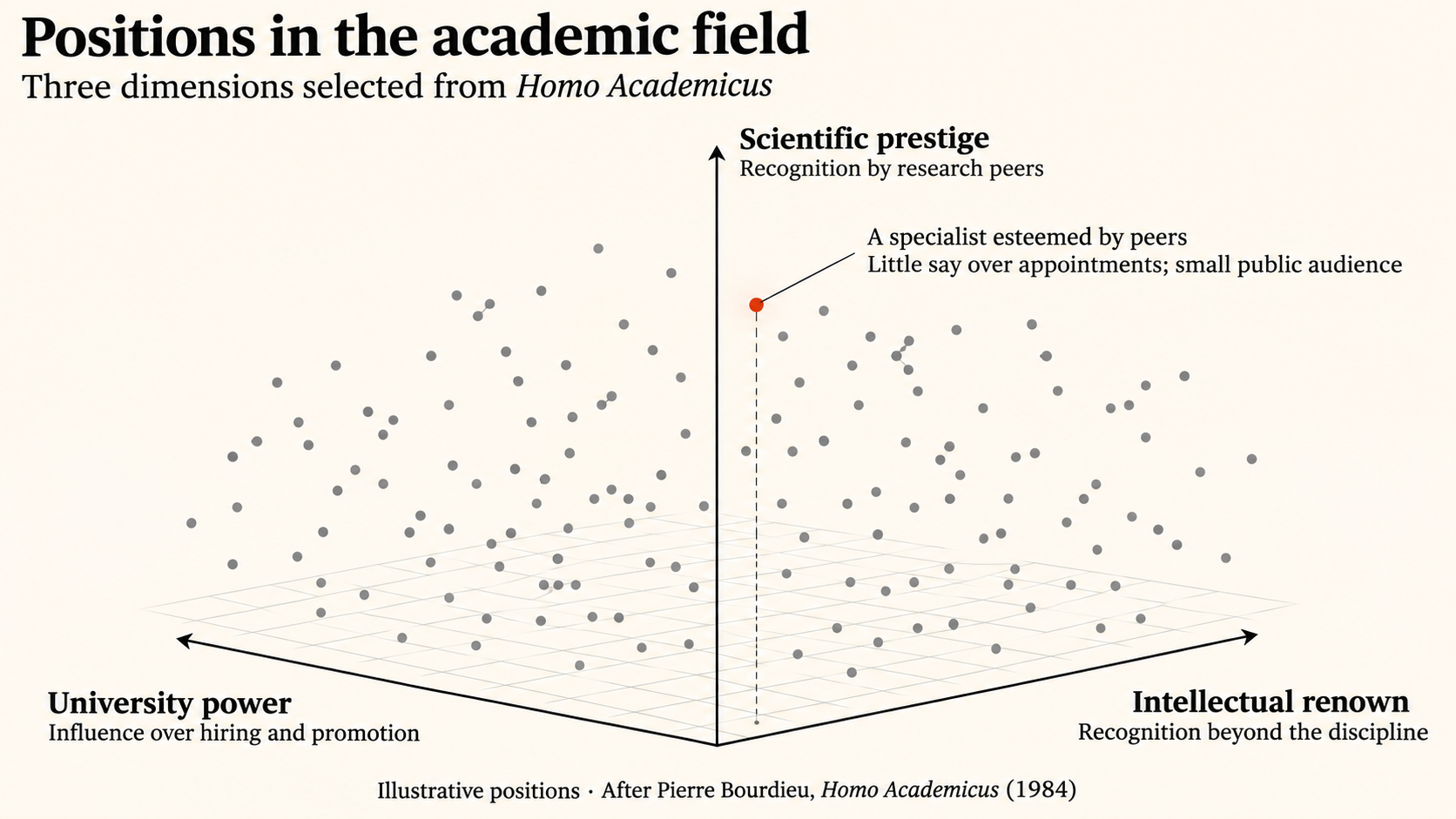
Someone can be respected by research peers and still have little institutional power or public recognition. Where do your sources get their authority?
A hole in your map is a candidate gap
02 · MAP & TEST
- THE FIRST CLAIM · “Nobody studies fairness in AI grading.” Too broad. The two sample sources both speak to fairness, but they examine different things.
- A QUESTION YOU CAN TEST · Can students spot and challenge a score that is too low? Look for studies connecting rubric-linked explanations, student challenge and an independently adjudicated score.
Until you search for that intersection, treat it as a question, not a finding.
Work backward from the gap
02 · MAP & TEST
- 01 · Score agreement What does agreement tell us? Where does it stop?
- 02 · Perceived fairness What do students report? What did the study actually observe?
- 03 · Ability to challenge What connects a student explanation to an independently checked score?
Draft a four-sentence route through the review. Give each section a job.
Workshop: make one choice inspectable
02 · MAP & TEST
Pairs · 18 minutes · Use your own gap claim and two sources.
- 4 MIN · Write State your provisional gap. Mark an assumption that shaped your source selection.
- 8 MIN · Compare Swap claims. Ask: What counts as evidence here? Who might use a different standard? What would disprove the gap?
- 6 MIN · Revise Tighten the scope or name one targeted search. Draft the route from your sources to the gap.
Take forward your original claim, the revised claim, and one unresolved question.
Ask AI to challenge the claim
03 · CHECK & ACCOUNT
Use your provisional gap and short descriptions of two sources.
What is the strongest reason my gap claim might be wrong? Identify one assumption and one search that could test it. Use only the evidence I provide; do not invent citations or rewrite the paragraph.
Use material you can share. A peer can play the same role without AI.
A useful objection still needs checking
03 · CHECK & ACCOUNT
Worked example · invented AI reply and study summaries
- 01 · AI objects “Source B already shows whether students can challenge a low score.”
- 02 · Check the source Read the method and results. Source B asked whether the explanation felt fair; it did not test recognition or challenge.
- 03 · Keep or reject Reject the claim about B. Keep the distinction. Search for work that actually observes challenges to scores.
A search lead is useful. A claim about a study needs a passage you can point to.
Run the check on your own draft
03 · CHECK & ACCOUNT
Individual work, then compare · 17 minutes
- 5 MIN · Get an objection Ask AI or a peer for one counterexample or competing interpretation.
- 7 MIN · Verify it Open the relevant source. Record the page or section and what it actually supports.
- 5 MIN · Decide Revise or defend your claim. Identify what remains uncertain or needs another search.
Keep the objection and the evidence, not just a polished paragraph.
A disclosure should name a decision
03 · CHECK & ACCOUNT
- TOO GENERAL · “I used AI for feedback.” This does not tell the reader what changed or what you verified.
- SPECIFIC · “AI challenged my distinction between fairness and accuracy.” I checked Source B’s interview protocol and found it did not test score accuracy. I kept the distinction and changed my search terms.
In your reflection, name what shaped your original choice.
What changes when AI enters the field?
03 · CHECK & ACCOUNT
One question to take into Week 7
If an AI routinely recommends the same familiar journals and methods, whose work becomes easier to find, and whose becomes easier to miss?
Name one way to check: compare search terms, indexes, venues, languages, or citation trails.
Next seminar: the future of scholarship and the final-review workshop.
Leave with three sentences
CLOSE
- 01 · Position What shaped a specific decision in my review?
- 02 · Contribution What did AI or a peer suggest?
- 03 · Judgment What did I check, keep, reject or revise, and why?
Keep your Week 4 draft and your Week 6 reflection separate. Use the class Google Doc for assignment instructions.
Where these questions come from
REFERENCE
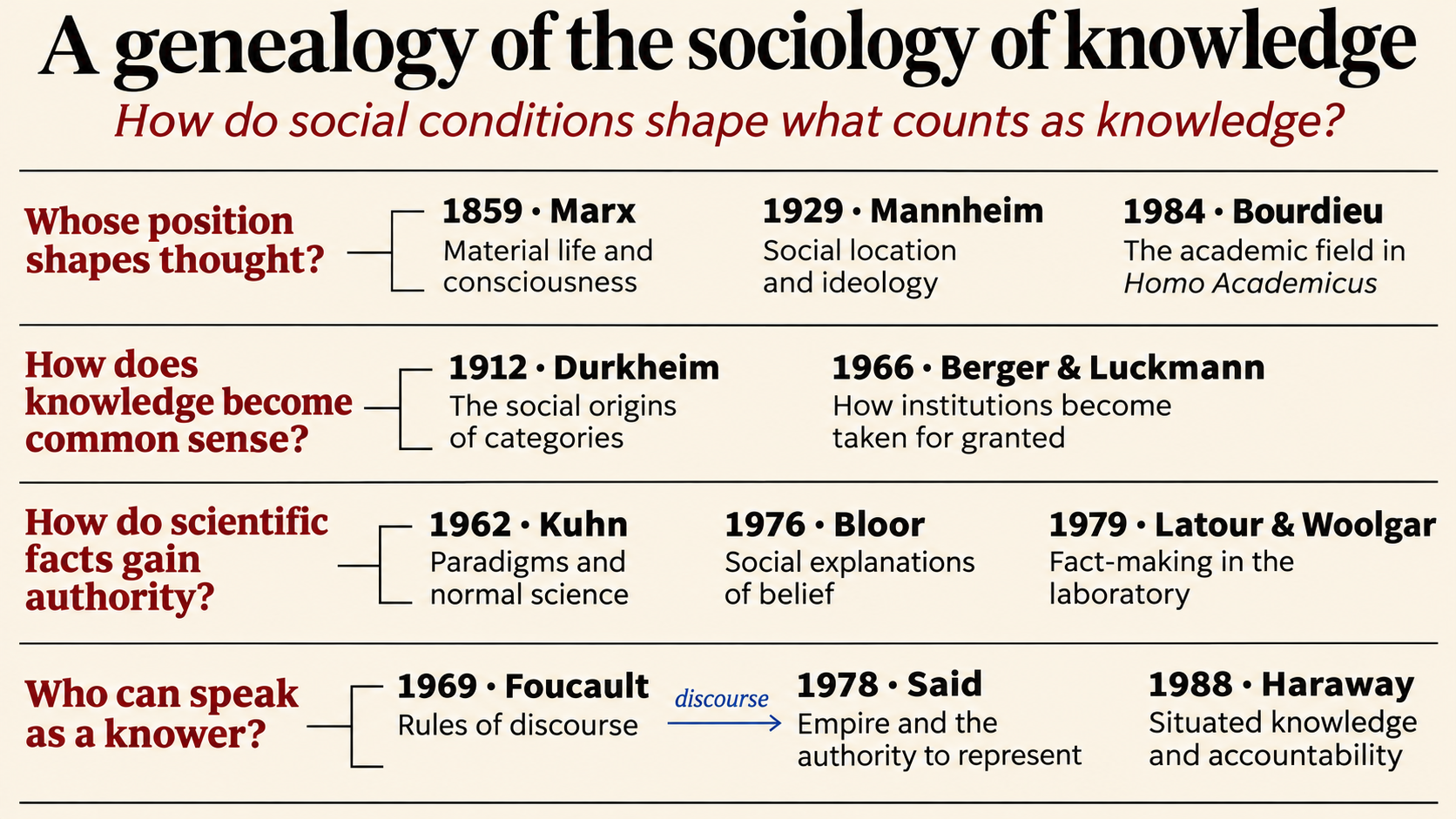
One map, four questions. The names give you places to read next, not a canon you need to memorise.
Readings and further connections
REFERENCE
- Bloor (1976; 2nd ed. 1991): “The Strong Programme in the Sociology of Knowledge,” ch. 1 of Knowledge and Social Imagery.
- Bourdieu (2003): “Participant Objectivation,” Journal of the Royal Anthropological Institute 9(2), 281–294.
- Ahmed (2004): “Declarations of Whiteness: The Non-Performativity of Anti-Racism,” borderlands 3(2).
- Kim (2025) · optional: “Reflection-AI: Artificial intelligence or algorithmic instruction problem?”
Assigned: one of Bloor or Bourdieu, plus Ahmed.
Words for doing something with sources
REFERENCE
- COMPARE · “Where A measures …, B asks …” Give each study its own question or standard.
- QUALIFY · “This supports …, but does not establish …” Tie the limit to a method, population or outcome.
- EXTEND · “I use this distinction to ask …” Show how reading changes the review’s question.
Other points of entry: Ricœur on suspicion (Marx, Nietzsche and Freud); Said, Orientalism (1978).