AI and Academic Literature, week 6
Reflexivity, positionality and AI in scholarship
20 scenes
590 Lecture 6
What We've Covered
- Week 1: Research Topic & Question
- Week 2: Method & Recipe for the Literature Review
- Week 3: Vibe Scholarship - Applying AI to Close & Distant Reading
- Week 4: Reading Spivak with AI & Writing for Humanities and the Sciences
- Week 5: Structuring the Literature Review
This Week
- Hour 1:
- Sociology of Knowledge and Applications to your Literature Review
- Reflexivity and Positionality: how do we interpret other scholarship?
- Hour 2: Group work - write a literature review summary
- Hour 3: How Do You Acknowledge AI in Literature Review?
- And What is AI doing to Academia and the state of Knowledge?
Next Week
- Synthesizing the course into a draft review
Sociology of Knowledge
- Study of academic / scholarly societies
- Navel gazing? Perhaps. But relevant for all academia because it helps us calibrate our writing (tone / citations )
- We've already touched on this
- Two Cultures (Snow (1959) – Humanities and the Sciences)
- But also: what are financial / political drivers of research? What are the conceptual or ideological frames? What are the standards for evidence or truth? Compare Spivak (1988) to Liu et al. (2025)
Sociology of Knowledge: Key figures & developments
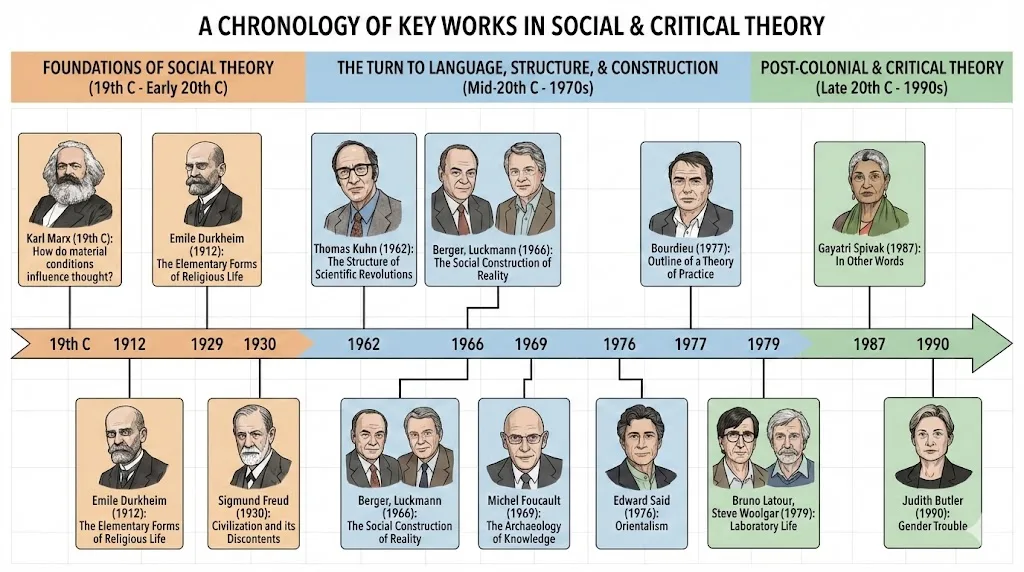
- Karl Marx (19th century): How do material conditions influence thought?
- Emile Durkheim (1912): The Elementary Forms of Religious Life
- Max Weber (1917): Science as a Vocation
- Karl Mannheim (1929): Ideology and Utopia
- Sigmund Freud (1930): Civilization and its Discontents
- Thomas Kuhn (1962): The Structure of Scientific Revolutions
- Berger, Luckmann (1966): The Social Construction of Reality
- Michel Foucault (1966): The Order of Things
- Michel Foucault (1966, 1969): The Archaeology of Knowledge
- David Bloor (1976), Knowledge and social imagery
- Bourdieu (1977): Outline of a Theory of Practice
- Bruno Latour, Steve Woolgar (1979), Laboratory Life
- Edward Said (1976), Orientalism
- Gayatri Spivak (1987), In Other Words
- Judith Butler (1990), Gender Trouble
Sociology of Knowledge: Key figures & developments
Courtesy of Google's Nano Banana Pro. Not quite right, but thanks anyway!
Sociology of Knowledge: Common Points?
- Thinking is not independent of conditions of life
- What are "conditions"?
- Class (Marx), race, gender (Said, Butler, Spivak)
- Social facts - fads & fashions (Durkheim)
- Ideology - what fundamental beliefs structure or make possible our thinking (Mannheim)
- Paradigms (Kuhn), epistemes (Foucault), habitus (Bourdieu): background forms of knowing and being
- Related to unconscious bias (Freud)
Why does this matter?
- Often asked to account for your positionality
- Hard to do! What is your unconscious bias? What are you conscious of being unconscious of?
- If you knew, it wouldn't be unconscious!
- Critique of critique - mobilized in the problem of "irregular verbs":
- "I think critically and independently"
- "You think according to the influences of your economic class and upbringing"
- "She / He / They think as unaware and naive victims of ideology"
Questions about an academic community:
- What is its jargon? Do you want to reproduce, challenge or modify this jargon?
- "Jargon" itself can be used as a piece of dismissive or pejorative jargon. All disciplines have and need their vocabulary...
- What are its standards of evidence? What does it find persuasive? What are the key questions it is asking?
- How stringent are its expectations about method, citation, formatting?
- What are its markers of distinction and discernment – "tickets to the game"?
- Conversely: what seem to be the things not to say?
How can you develop this tacit sense? Possibilities:
- Treat it like a research project - study academics like an community
- Read journals
- Attend conferences
- Observe faculty
- Join committees
- Read or scan 'campus' novels & drama
- Maintain a reflective journal
- Share your own research, ask for feedback
- Ask AI to play the role of an academic in a field
- All of this can be input into a discourse analysis or thematic analysis of a field
- Is it over-thinking?
Relationship to Literature Review
- Write with your audience in mind
- But - very important! – not as though you are already "in the club"
- Take a reference to Spivak. You might know your audience is likely familiar with Spivak's work. But of course you don't say:
- "As we all know, Spivak argued that"
- Instead it is as though your audience forgot Spivak's point and you gently remind them: "Spivak argued that..."
- But then you might twist this familiarity: "In the age of AI, it might seem Spivak's arguments regarding grammatization have dated. However,..."
- So a literature review can translate your own sociological research into some careful phrasing that both reassures and surprises your community
Reflexivity and Positionality
- Most people are familiar with ideas of reflexivity and positionality
- As we have seen, can be difficult to describe in relation to our own position
- Discussed in a lot of literature and traditions
Reflexivity and Positionality: Example of Bourdieu
- What reflexive positionality is not:
- autobiography or identity ("as an Australian white male...")
- radical self-doubt ("given my positionality, all truth claims I make are necessarily flawed...")
- instead it aims to understand the academic self who speaks...
- part of a liberal settler/colonial academic tradition
- informed by history, syllabus, academic canons, experience of teacher influence (inner critical voice) - Bourdieusian concept of habitus
- these influence (not necessarily determine) what it is that I say, how I interpret
Reflexivity and Positionality: Example of Bourdieu
- Strangely a Bourdieusian sene of positionality is everything that is not me - but rather the structural conditions under which
- I find such-and-such to be problem (e.g. why do I perceive it to be unethical - where does my sense of ethics come from?)
- I find this or that theory appealing
- I prefer scientific / humanities writing prerrable
- For Bourdieu, reflexivity is like the holding up a mirror - but then paying attention to everything in the background of the self
Reflexivity and Positionality (2)
- Generally discussed in relation to methods and data analysis
- How does it affect the literature review? What is it that we bring to the table when we read academic writing?
- Discuss!

Breaking the rules: From gap to structure
- Sometimes you know what the gap is. The structure of a review feels like fraudulent - as though you are pretending to explain to the reader this and that about the literature review, only to arrive at some kind of magical gap.
- Remember Marx: order of presentation not always the order of analysis (not a statement about Marx' politics!)
- Can we learn from this? Can we work backwards? From example, from gap to special field to general field?
Detective Novel: Start with 'whodunnit', work backwards
- Start with a statement of the gap (solution to the crime)
- Surround the gap with the narrative - the key actors, the setting, the clues...
Collaborating with Others (including AI) on the Literature Review
- Review Week 5 - Structuring the Literature Review
- Discuss: what worked? what didn't?
- Now imagine you have discovered the gap in the literature
- Develop it as a statement, and write it down under "Week 6"
- Write a non-existent summary of your literature review
- Purpose: introduce a reader to your topic
- 4-5 sentences
- Use signposting / metadiscourse heavily
- If you have a preferred structure from week 5, use that
- Sample: "In this review, I start by discussing A... I then examine research on B... I further consider C... Finally I show how none of A, B or C address the issue of D."
- Review each other's statement of a gap
- Write a single sentence about each other person's summary. Assess what you found (a) clear (or unclear); and (b) whether - just from the summary – you thought the claim about the gap could be persuasive
- Take notes on your own tab of what others say
- Then ask an AI of your choice to review your summary paragraph on the same criteria: clarity, likelihood of a gap
- Finally refine the summary paragraph yourself and add that to week 6.
Homework: AI in Scholarship
- What do you say?
- Let's take the group exercise, and write one or two sentences about how you thought AI contributed