AI and Academic Literature, week 4
Difficult texts, audiences and scholarly voice
52 scenes
EPOL 590 - AI and Academic Literature
EPOL 590: AI and Academic Literature | Monday, November 9, 2026 | 5:00–7:50 p.m. Central
590 Lecture 4: Difficult Texts, Audiences and Scholarly Voice
Today
- Activity 1: Discuss Structuration and Metadiscourse
- Mapping, Strategies, General discussion
- Activity 2: "Vibe Scholarship" - Fast Drafting Review
- In the Scientific Mode
- In the Humanities Mode
- Activity 3: Slow & Critical Reading with AI (if there's time). Case studies:
- "Can the Subaltern Speak?" (Spivak, 1988)
- "Can Large Language Models Review the Scientific Literature?" (Al Kalbani et al., 2026)
Where we are in the course
- Week 1 (19 October): Research questions and academic literature
- Week 2 (26 October): Article anatomy, review design and mapping a field
- Week 3 (2 November): AI-assisted close and distant reading
- Week 4 (9 November): Difficult texts, audiences and scholarly voice - tonight
- Week 5 (16 November): Structure, signposting and scholarly communities
- Fall break (23 November): no seminar
- Week 6 (30 November): Reflexivity, positionality and AI in scholarship
- Week 7 (7 December): The future of scholarship and final review workshop
- Final submission: 15 December
Recap on Week 3
- Moretti's distant reading; Snow's two cultures
- Two groups, two seed articles on AI alignment - Humanities and Science
- Coding and mapping a database: chronological, thematic, relational, spatial
- Start an AI-use record
Keep AI Handy...
- As we go, it'll be helpful to have your AI of choice open
- Consider using an AI you're less familiar with
- Free versions ought to be fine
Some Discussion about AI and its Discontents
- Cognitive offloading, lock-in
- I no longer own what I attach my name / signature to
- I lose the (difficult) pleasure of research (reading, interpretation)
- I am prey to the "unconscious bias" of the machine (Magee et al. 2023, "Structured Like a Language Model")
- People lose trust in me / my profession / epistemic authority generally
- Endpoint? A return from episteme (evidence-based reproducible truths) to doxa (choose your own truth)
- A crisis of educational institutionalism?
One Suggestion: Field Notes for the Literature Review
- Task 6 will ask you to explain where AI influenced your searching, reading, mapping or writing; what you checked; what you rejected; and what responsibility you retained
- Start keeping notes now: which tool for searching, what you asked, what you checked, what you kept and what you rejected. Imagine you are audited (you won't be!) - how would you defend your choices?
- Be reflective on AI use: "I summarized these 10 articles with AI. It wasn't helpful, I didn't appreciate any of the detail myself. So I used AI again to break each article down."
- Re-orient perspective: not a tool for efficiency so much as depth - "how do I really explore strengths and limitations of perspective A, with AI as a complementary critical lens - with its own biases? How can I get an enriched triangulated perspective?"
- Other Strategies? Discuss!
How do I Structure A Literature Review?
We have been discussing principles for organizing a literature review.
Some examples
- General > Special – can confirm but also contrast ("General theories of pedagogy suggest... However studies of adult language learners also show...")
- Chronological ("By the 1960s, discussions of AI had already become more muted...")
- Thematic ("The concept of 'attention' is used in roughly similar ways in machine and human learning...")
- Spatial ("Studies in Asian universities show that ...; in contrast, findings from North American universities suggest...")
- Developmental ("First I will discuss Descartes' presentation of the mind/body problem. I then move on to look at 20th century critiques of this distinction....")
- Relational ("Authors X and Y argue.... Claiming systemic flaws in X and Y's methods, Z suggests...")
- Other?
- Nested Categories (chronology then thematic, etc)?
Some Guiding Notes
- Specialization: Can work well when you want to convey a sense of narrowing down a focus: Education > K12 > Math learning > Algebra > in rural Mid-west schools
- Chronological: Can work well when you want to convey a sense of progress
- And how your work extends that progress
- Thematic: Can work well when you want to convey a sense of overlaps, intersection and gaps
- And how your work discovers and fills one of these gaps
- Spatial: Works well when you want to convey a sense of cultural, spatial or geographic difference
- And how your study attends to a location or zone not previously studied
- Developmental: Works well when you plan to build your argument through a sequence of positions / thinkers / ideas
- And show how you will blend, contrast or critique all of these positions / thinkers / ideas
- Relational: works well when you find a key schism or debate in the literature
- And show how you will contribute / sidestep / undermine the terms of that debate
How do I Decide?
- Typically recursive and iterative:
- Go forward to discover the gap
- Move back from the gap to discover the structure
- Experiment with different structures
- Mock up your structure
- What helps me make the best case: that an argument exists?
General > Special
- General > Special: "As this review shows, the student service field has been calibrating to emerging health and wellbeing trends among higher education students. Less is known about how health science professional students - a specific cohort with attuned sensitivity to these trends - can be better served by student services. My research aims to address this gap by..."
- General: higher ed students; specific / special: health science professional students
- One strategy: find a specialized cohort / population among a more general population that might have meaningful differences
Chronological
- Chronological: "As this review shows, the literature has yet to document the rapid rate of change in AI products used in K-12 education, and the commensurate development of school-based policy to assess and control these products. My research aims to address this gap by... "
- One strategy: find where literature lags developments in real world practice
Thematic
- Thematic: "As this review shows, considerable attention has been devoted to questions of cognitive load, multimodality and the rise of learning analytics in higher education. Few studies have yet explored the intersection of these three themes. This leads me to ask: what forms of evidence allow us to determine the differential impacts of multimodal learning resources on students' cognitive load?"
- One strategy: find overlooked intersections between themes
Spatial
- Spatial: "As this review shows, despite the attention to use of AI in urban middle schools, relatively little has been studied in relation to rural middle schools. By studying use of AI at a middle school in central Illinois, this research aims to fill a gap..."
- One strategy: find a country / state / zone / city that has been understudied
Developmental
- Developmental: "As this review shows, recent work in philosophy of mind has responded to the emergence of AI with extended definitions of sentience, consciousness and cognition. However, this work is yet to address the related idea whether intention can be divorced from consciousness, and become an independent construct to be assessed in computational as well as biological organisms..."
- One strategy: find two or concepts that are seldom referenced together (see earlier: Magee et al. 2023, "AI" and "the unconscious")
Relational
- Relational: "Authors X and Y both argue that childhood development is largely unimpacted by high use of technological devices. Claiming flaws in the methodology of X and Y, Z instead analyzes recent longitudinal data..."
- One strategy: find a famous argument / academic antagonism (Chomsky vs Pinker; Derrida vs Searle; Honneth vs Fraser)
Systematic Reviews (related to: Meta-analysis)
- A sub-class of articles that only review - to highlight gaps
- Great if you can find them: these make your argument for you
- Necessary but not yet sufficient: Is the review comprehensive? Is it biased? Has it dated? Do you trust their methods?
- Still best practice to reinforce with a review of your own
Retrospective Reviews
- "I have a finding - is it novel? Search the literature to find out..." (problem of data-driven research)
- Or: "I did my review in 2025 and found a gap. I conducted my study in 2026 based on that gap. But has someone filled it in 2026?"
- Useful to consider "review" an ongoing process / conversation
A Note on Triangulation
- AI or not to AI?
- Mix AI systems: Does Gemini agree with ChatGPT? What about DeepSeek (do Chinese systems differ from US systems)?
- Mix AI with other computer resources (Google Scholar, databases, even - sometimes - Reddit)
- Mix AI with human sources: peers, librarians, advisors, students, professionals
Can Large Language Models Review the Scientific Literature? A Test Against a 102-Article Benchmark
- Al Kalbani et al., 2026 - https://arxiv.org/abs/2611.05459
- Takeaway: AI can augment - but certainly can't automate - literature reviews
- Misses parts of the literature systematically (like humans - recency bias)
- Its synthesis of literature is generic.
- Misses conflict (and we want to sell our research; we want drama in our reviews). Consider: steady state scientific progress vs Kuhn's (1962) explosive "paradigm shift"
- Largest inhibitor? Library access!
- Claude Opus 5: 15 -> 79 / 102
Eight recommendations (Al Kalbani et al., 2026)
- Search with subscription access, and audit where and why the tool was blocked.
- Search publishers' sites and databases directly, since gaps may reflect access, not an absence of literature.
- Search separately for older work.
- Judge each article's importance yourself.
- Write detailed prompts, including inclusion and exclusion rules and the kind of answer expected.
- Check claims and quotations against the sources.
- Don't take a tool's confidence as a sign it is right.
- Have a human expert review the output.
The Empire Strikes Back? Claude's (2026) Advice
- Search with access: run your AI signed in to the UIUC Library, and keep a log of where it was blocked (paywalls, CAPTCHAs, sites that refuse AI)
- Don't let it bulk-download PDFs; publisher licenses forbid it
- Search yourself too: search the databases yourself (Google Scholar, ERIC, Scopus), then give the AI your list to deduplicate, check and follow citation trails
- Search separately for older work, which the AI tends to miss
- Supply the full texts: Zotero + UIUC Library → put the PDFs in your AI's project or folder
- Define your categories: what counts as "central" vs "passing"? Give an example of each, and require a quote + page number for each judgement
- Code 10–15 articles yourself first and compare with the AI
- Verify the synthesis: treat it as a list of claims to check, not a draft
- Check the quotes, ask who disagrees, and trace definitions back to their original source
- Don't trust the AI's confidence: it is your expertise that catches the errors
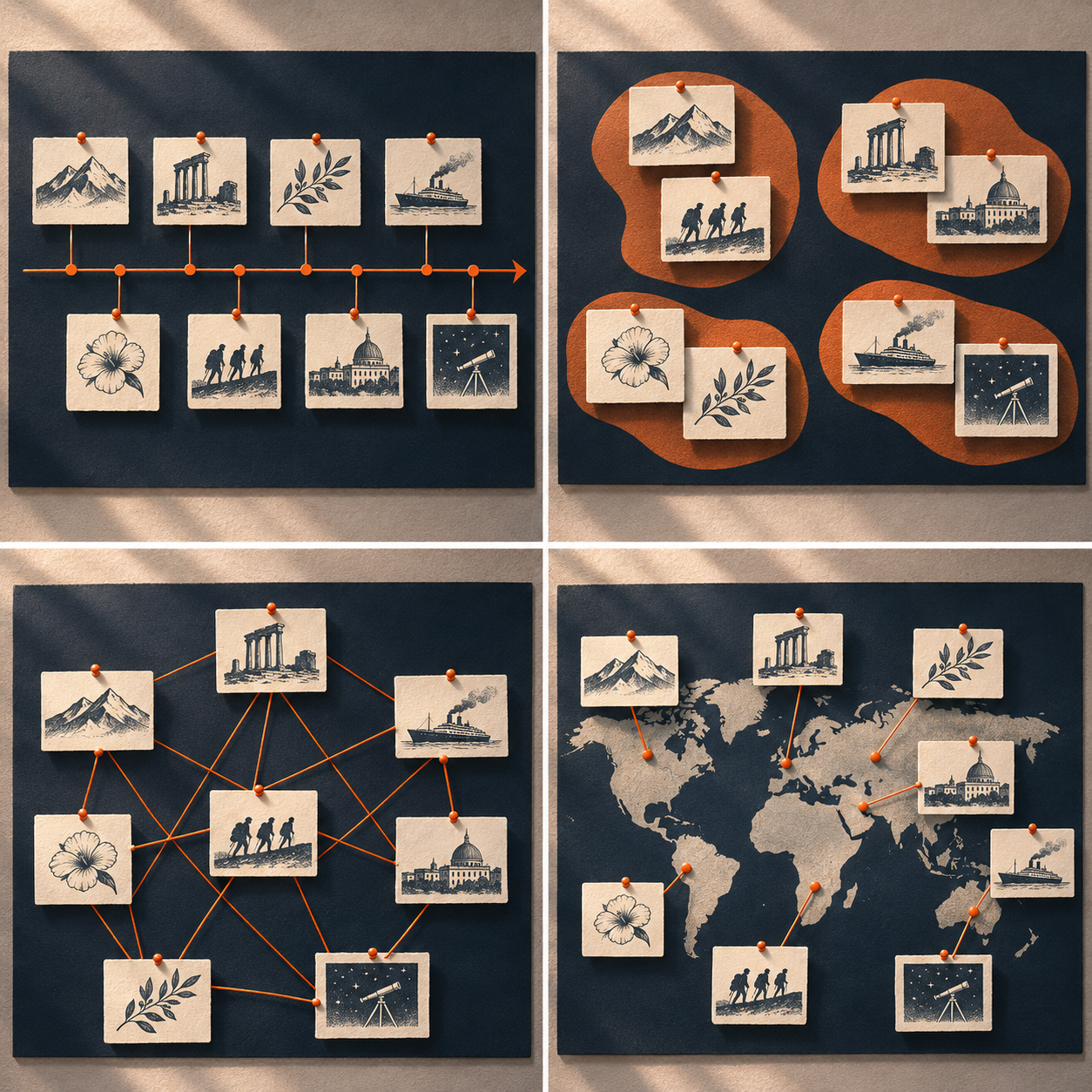
Strategies for literature mapping
Consider the organizational approaches:
- Chronological (this literature follows from this other literature)
- Thematic / conceptual (this literature discusses this theme; this other literature discusses this other theme - and this is where they overlap / differ)
- Spatial (this literature studies phenomenon X in the US; this literature studies phenomenon X in South Africa)
- Developmental (this literature contributes this part; this other literature contributes another part...)
- Relational (this literature relates / responds to this other literature)
Can we start to make sense of our emergent database via one or more of these approaches?
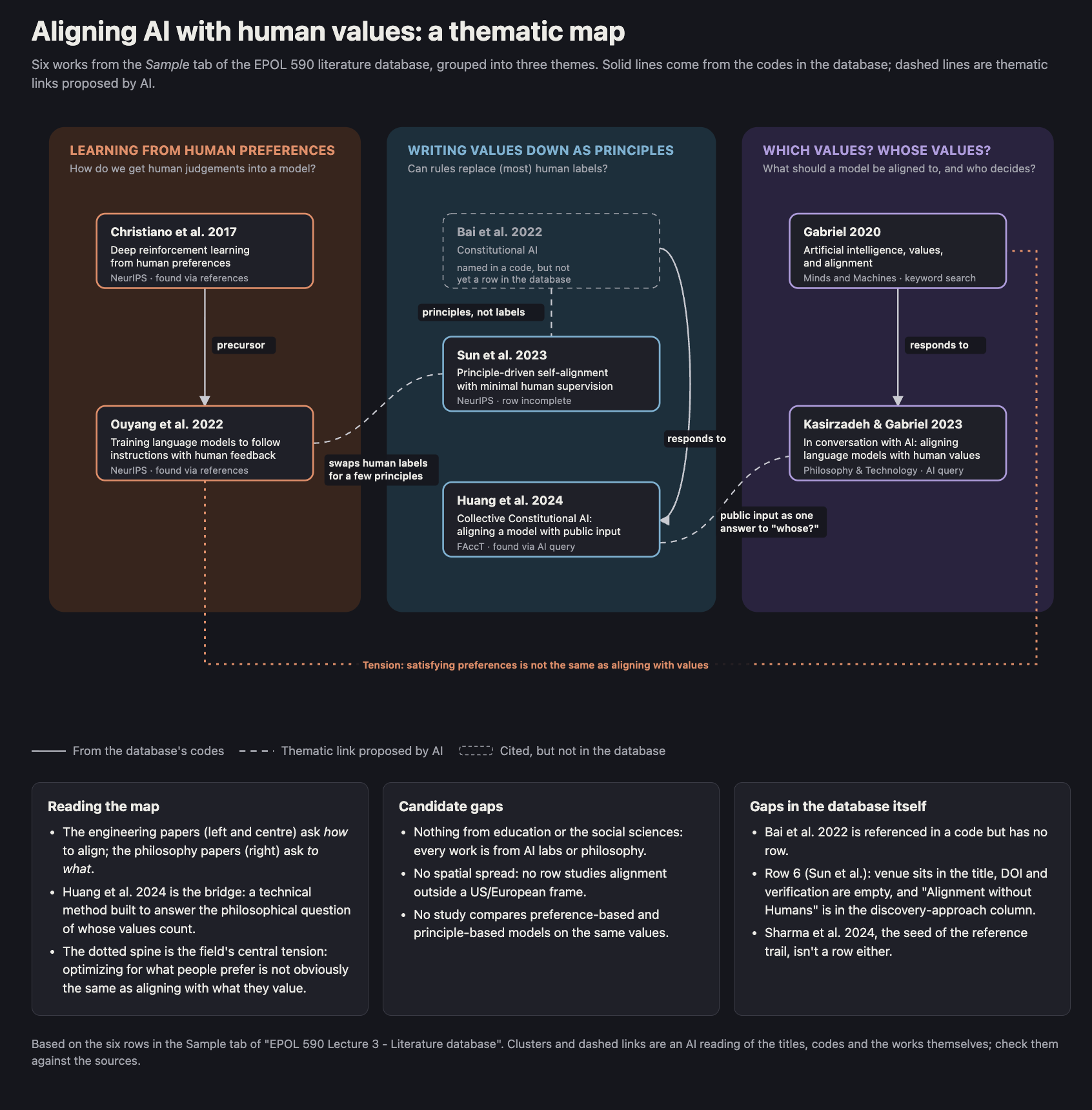
Generate and visualize the mapping
- Ask AI to generate a visualization of the mapping
- A mock literature review structure
- A mock statement of the gap in the literature
Sample prompt:
"From this coded database, generate a rich visual map of the key [chronological, thematic or relational] connections between these works."
Aside: using text as interim format for images
Why? More plastic / fluid representation
Example: Mermaid is a plain text format - so very easy to iterate on with AI - "contract it", "expand it", "simplify it" etc.
ChatGPT: generates Mermaid diagrams
Also works for other formats, e.g. SVG (Scalable Vector Graphics). Allows you to evolve & iterate a representation
New Breakout Rooms
In the same database as Week 3, use one or more of the mapping strategies to apply codes (Mapping principle, Our code)
- For example, choose "Chronological" and add, for example, "early 20th century", "1980s", "2020s"
- Or "Thematic", and add, for example, "philosophies of alignment", "human values"
- Or "Spatial", and add, for example, "examines differing approaches between East Asian and American companies to AI alignment"
- Or "Developmental", and add, for example, "Contributes X to the literature"
- Or "Relational", and add, for example, "cites Sharma et al."
Then ask AI to do the same, and record its codes alongside yours (this could even be Gemini in Google Sheets, if that is enabled)
General discussion
- Share the visualizations, mock structure and gap in the literature
- Reflect: what are the affordances of AI for literature discovery and mapping? Where does it fit - or "align" - with traditional approaches? What are the risks? Do we agree with Al Kalbani et al. (2026)?
Break
Metadiscourse / Signposting
- Assume your reader does not know the literature
- A literature review is often pedagogical - teaching the reader about a field, in order to persuade them about the gap your research fills
- Helps you in authoring - does Y really follow from X?
- Be prepared to write / re-write this metadiscursive text often - especially early, as you experiment with structural principles (chronological etc)
Making It Explicit (Nod to Robert Brandom)
- Cannot be too explicit about your structure:
- Introduction (future tense):
- "In this literature review I will..."
- (or if you prefer) "This review will..."
- Conclusion (past tense):
- "In this review, I have discussed literature relating to..."
- (or if you prefer) "This review has..."
- Along the way:
- "In the last section, I discussed.... In the next, I will..."
- Can be blended through connective language. "While the preceding studies illustrated how use of AI in education has been studied extensively, less has been said about how AI contributes to the student/teacher relationship. Some exceptions include studies by X, Y and Z..."
- Introduction (future tense):
Develop a Repertoire of Metadiscourse
- Ask AI for suggestions...
- "Give me examples of metadiscourse for a literature review"
- Or "Give me a table and distinguish between metadiscourse used in (a) scientific and (b) humanities discussions of literature"
Practice in Groups...
Using 3-6 sources from your database (Week 3), develop:
- A paragraph of a scientific literature review
- A paragraph of a humanities literature review
- Ask AI to re-write both. Prompt for excessive and *exaggerated
- Then reflect upon the pros and cons of (a) scientific and humanities approaches and (b) what AI is doing when it re-writes a review
Make sure to introduce and conclude the paragraph. Exaggerate the scientific and humanities styles – and the metadiscourse!
The Scientific literature review
- What does your scientific audience expect?
- Use [2510.01171] Verbalized Sampling: How to Mitigate Mode Collapse and Unlock LLM Diversity - or other examples
- Write 4-5 sentences - cite 4+ references
- Use metadiscourse to introduce / compare / contrast / conclude / transition the paragraph
- 10 minutes - use the class document (Week 4 Collaboration)
The Humanities literature review
- What does your humanities audience expect?
- Use Spivak (1988) - or other examples
- Write 4-5 sentences - cite 1+ references
- Use metadiscourse to introduce / compare / contrast / conclude / transition the paragraph
- 10 minutes - Use the class document (Week 4 Collaboration)
Finally
- Read both versions
- (Optional) Ask AI to add even more "metadiscourse" to the text
Discuss
- Which did you prefer to write? Which did you find more persuasive to read?
- What kind of audience would you usually write for?
- Could you imagine blending these two extremes?